
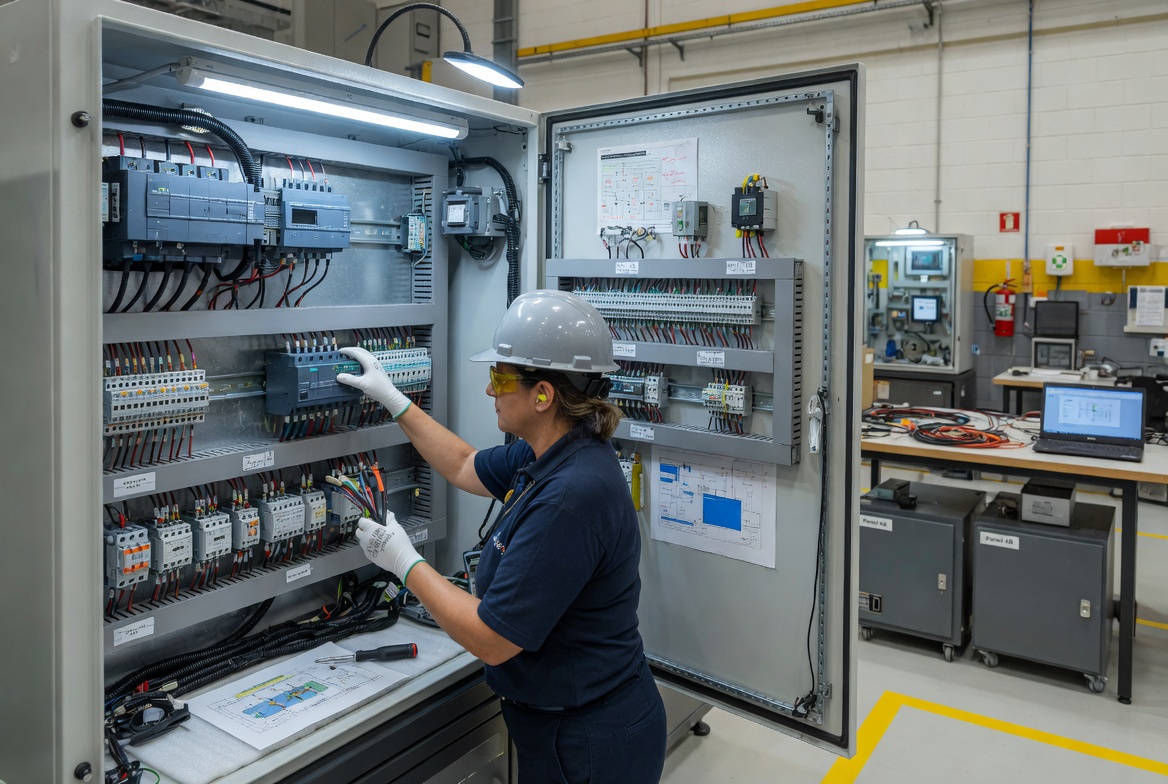
How to Choose a Bespoke Control Panel Manufacturer in the UK: A 7-Step Engineering Checklist
Procuring a bespoke industrial control panel or motor control centre (MCC) is one of the highest-stakes capital investments a UK manufacturing plant will make. Choose the right engineering partner, and your production line runs deterministically with 99.8% uptime for decades. Choose the wrong low-bid wireman, and you inherit unexplained nuisance trips, thermal overheating shutdowns, catastrophic fault level non-compliance, and proprietary software lock-in.
Separating Certified Engineering Systems from Unregulated Wiring Shops
In the UK market, the term "control panel manufacturer" spans everything from lone electricians working out of garages to world-class accredited systems integration houses. Under UK statutory legislation (specifically the Electricity at Work Regulations 1989 and the Supply of Machinery Regulations), the legal entity that assemblies a control enclosure carries full criminal and civil liability for short-circuit containment, electric shock prevention, and functional safety architecture.
This comprehensive buyer guide outlines the 7 non-negotiable engineering criteria that Plant Managers, Operations Directors, and Capital Project Leads must evaluate before signing a purchase order with any UK panel builder.
The 7-Step Engineering Checklist for UK Panel Buyers
Evaluate every potential vendor against these essential technical, compliance, and commercial benchmarks before issuing an RFQ.
Compliance with BS EN 61439-1/2 & Forms of Separation
The foundational standard for UK low-voltage control panels is BS EN 61439-1 & BS EN 61439-2. Unlike superseded standards (such as BS EN 60439), BS EN 61439 completely eliminated the distinction between "Type Tested" (TTA) and "Partially Type Tested" (PTTA) assemblies. Every completed panel must have 13 distinct design verifications documented in a formal Technical Construction File.
For Motor Control Centres (MCCs) operating in continuous manufacturing (such as food, chemical, or automotive plants), you must verify the internal forms of separation. A quality manufacturer will build to Form 4 Type 2 or Form 4 Type 7, meaning busbars, functional starter compartments, and outgoing cable terminations are completely isolated behind metallic barriers.
Form Separation Quick Reference:
- Form 1: No internal separation (high flashover hazard during servicing).
- Form 2: Busbars separated from starter compartments.
- Form 4 Type 2: Busbars, units, and terminals completely segregated.
- Form 4 Type 7: Full isolation including individual gland plates per circuit.
Short-Circuit Current Ratings (SCCR) & Prospective Fault Calculations
A catastrophic short-circuit fault inside a control panel generates explosive electrodynamic repulsion forces scaling with the square of peak current (Ipk²), capable of ripping copper busbars from their supports in milliseconds. Competent manufacturers calculate and verify Short-Time Withstand Current (Icw) and Conditional Short-Circuit Current (Icc) per our SCCR calculation guide.
Uncertified panel builders frequently commit the dangerous error of installing a 50 kA main breaker while feeding cheap 10 kA terminal blocks or miniature circuit breakers without proven upstream current-limiting coordination. If a bolted fault occurs, the assembly rating collapses to the 10 kA component, creating severe arc-flash risks.
Critical Fault Verification Metrics:
- Icw (kA / 1 sec): Busbar withstand without upstream protection.
- Icc (kA): Conditional fault rating with specific upstream MCCB/fuses.
- Electrodynamic Force: Busbar support deflection calculations to Annex P.
Certified Quality Frameworks: ISO 9001, ISO 17020 & ISO 17025
Any vendor can claim to follow high standards, but independent third-party accreditation separates elite engineering firms from non-compliant shops. MASK Control Systems operates under a tri-certified quality management umbrella spanning ISO 9001 (Quality Management), ISO 17020 (Inspection Bodies), and ISO 17025 (Testing & Calibration Laboratories).
This quality rigor ensures that torque wrenches used on busbar bolts are calibrated to traceable national standards, wire crimps undergo calibrated pull-force verification, and every engineering modification follows strict change-control procedures with immutable technical sign-offs.
The MASK Tri-Certified Standard:
- ISO 9001: End-to-end design, build, and QA workflow tracking.
- ISO 17020: Independent inspection protocols on electrical builds.
- ISO 17025: Traceable instrument calibration for sensors and torque tools.
Multi-Platform PLC Fluency & Unrestricted Code Ownership
A major red flag during procurement is a control panel builder who defaults to only a single PLC vendor because their programmers lack broader skills. The ideal partner offers vendor-agnostic architecture, selecting the controller that best matches your existing factory ecosystem:
Crucially, ensure the contract specifies that you receive 100% unrestricted ownership of uncompiled PLC/HMI source code upon commissioning. Never accept proprietary passwords or locked function blocks that hold your plant hostage.
Software Deliverables Checklist:
- Uncompiled project archives (.zap18, .acd, .gx3).
- Fully annotated tag databases and alarm lists.
- Deterministic multi-vendor fieldbus mapping (Profinet / EtherNet/IP).
Thermal Management & Ingress Protection (IP54 / IP65 / IP69K)
Industrial automation components (especially VFD inverters, servo drives, and 24V power supplies) generate massive heat loads. A high-spec panel in a steel foundry or bakery will quickly exceed internal component ratings (typically 50°C maximum) if thermal dissipation is not calculated to BS EN 61439-1 Clause 10.10. Review our thermal management calculations guide.
Furthermore, if your panel operates in food and beverage washdown areas, verify true IP66 vs IP69K stainless steel enclosure design with sloped hygiene roofs, blue silicone FDA-compliant gaskets, and hygienic cable glands.
Thermal & Ingress Safeguards:
- Active thermoelectric or compressor air conditioners for high-dust plants.
- EMC shielded cable glands preventing high-frequency VFD noise (BS EN 61800-3).
- IP69K 316L stainless steel for 1450 psi high-pressure washdown.
Factory Acceptance Testing (FAT) Protocols & Simulation Rigor
The most expensive place to find an electrical wiring mistake or software bug is on your live factory floor during a scheduled shutdown. A world-class panel manufacturer executes exhaustive Factory Acceptance Testing (FAT) at their own facility prior to delivery.
At MASK, FAT protocols include 100% point-to-point electrical wire buzz checking, high-voltage insulation dielectric testing, simulated 4-20mA sensor signal injection, and full PLC simulation with connected HMI displays. Emergency stop pushbuttons, interlocked safety gates, and optical light curtains are physically tripped to verify ISO 13849-1 Cat 4 / PLe safe state execution.
Essential FAT Execution Steps:
- Point-to-point buzzer continuity against EPLAN schematics.
- Dielectric flash insulation testing to BS EN 61439-1.
- Live software simulation of all interlocks and recipes.
Turnkey Installation, Site Commissioning & 24/7 Breakdown SLA
Many panel shops simply build a box, ship it to your loading dock on a pallet, and leave you to coordinate external electrical contractors, mechanical riggers, and software integrators. When commissioning issues arise, the finger-pointing begins.
A true turnkey engineering partner takes single-point responsibility: from initial site survey and electrical schematic generation to control panel fabrication, on-site installation and commissioning, and long-term 24/7 emergency breakdown support.
Full Turnkey Capabilities:
- Complete EPLAN CAD schematics and O&M manuals supplied.
- Nationwide flying commissioning engineers across England, Scotland & Wales.
- Encrypted remote telemetry diagnostics for rapid fault triage.
Comparing Control Panel Builders in the UK
See how different tiers of panel builders stack up against critical engineering and commercial benchmarks:
| Engineering Benchmark | Low-Cost Wireman / Non-Certified | Bureaucratic Tier-1 Global OEM | MASK Control Systems Ltd |
|---|---|---|---|
| BS EN 61439 Form 4 Separation | Rarely offered; typically Form 1/2 only | Available at extreme cost premia | Standard Form 4 Type 2/7 design |
| SCCR & Fault Calculations | Assumed 10 kA default; no calculation | Calculated but inflexible standard ranges | Custom Icw / Icc verified up to 65 kA+ |
| Accredited Quality Systems | None; unverified workshop tools | ISO 9001 standard | Tri-Certified: ISO 9001 / 17020 / 17025 |
| PLC Software Ownership | Often locked or password-protected | Recurring enterprise software licenses | 100% uncompiled source code provided |
| Multi-Vendor Agility | Locked to 1 familiar brand | Default to their own proprietary hardware | Full fluency: Siemens, Rockwell, Mitsubishi, etc. |
| FAT Testing & Simulation | Basic buzzer check only | Rigid scripted FAT with costly change orders | 100% point-to-point and live software simulation |
| Direct Engineer Access | Direct, but limited engineering depth | Layered account managers & slow responses | Direct collaboration with senior systems engineers |
Planning a Control Panel Build or MCC Upgrade in the UK?
Work with an accredited UK engineering partner who guarantees BS EN 61439 Form 4 compliance, verified short-circuit ratings, open PLC code, and turnkey commissioning.
Devon Headquarters • Nationwide UK Engineering Delivery • Tri-Certified Quality Management
Questions Buyers Ask When Choosing a UK Panel Builder
Critical engineering insights regarding statutory standards, software ownership, and FAT verification protocols:
What statutory standards must a UK control panel manufacturer comply with?
What is the difference between an Assembly Manufacturer and an Original Manufacturer?
Why is Form 4 separation critical when buying industrial motor control centres (MCCs)?
What should be included in a formal Factory Acceptance Test (FAT)?
Do I own the PLC source code when purchasing a bespoke control panel?
How does thermal calculation prevent summer plant shutdowns?
Explore More Control Engineering Articles
Forms of Separation Guide (Form 1 to Form 4)
Understand internal busbar segregation, operational safety, and maintenance rules for UK MCC switchboards.
Control Panel SCCR & Fault Calculations
How prospective fault levels, Icw, and current-limiting devices protect busbar structures from explosion.
Bespoke Control Panel Design Services
Custom electrical panel design, Form 4 switchgear, EPLAN schematics, and UKCA certified build services.