
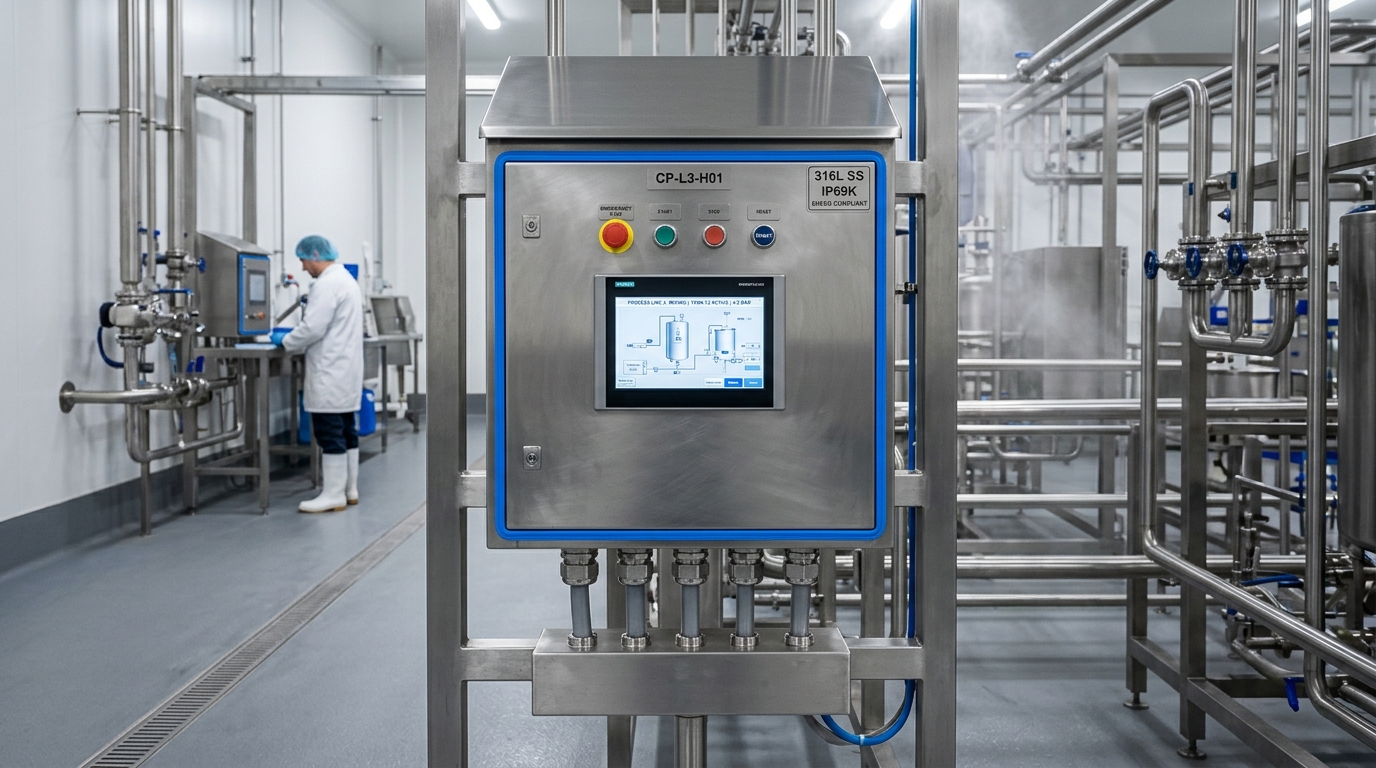
In modern UK food processing facilities, dairy plants, and beverage bottling halls, electrical enclosures exist in one of the most hostile industrial operating environments on earth. Every day, production stops so sanitation teams can blast processing machinery with chemical sanitizers (sodium hydroxide caustics, peracetic acid, and chlorine foams) followed by high-pressure hot water washdowns reaching temperatures up to 80°C and pressures exceeding 100 bar.
Under these unforgiving conditions, standard industrial electrical enclosures fail within months. Microscopic gasket defects allow washdown water to penetrate the cabinet, causing catastrophic short circuits, corroding expensive programmable logic controllers (PLCs), and halting high-volume packaging lines at costs exceeding £15,000 per hour.
Even worse than electrical failure is the biological threat: standard enclosures feature horizontal ledges, exposed screw threads, recessed corners, and porous black rubber gaskets where organic matter and washwater stagnate. These hidden dead zones become breeding colonies for lethal pathogens such as Listeria monocytogenes, Salmonella, and Escherichia coli.
To eliminate both electrical downtime and biological contamination, UK machine builders and plant engineers must design control panels in strict compliance with the European Hygienic Engineering & Design Group (EHEDG) directives and BS EN 1672-2:2020. This comprehensive engineering guide explains the critical technical differences between IP66 and IP69K ratings, the physics of hygienic enclosure design, and how to build zero-defect washdown automation systems.
1IP66 vs IP69K: The Physics of Washdown Resistance
The most prevalent misconception in industrial panel specification is assuming that an IP66 enclosure is adequate for food and beverage washdown areas. While both ratings offer complete protection against solid ingress (indicated by the first digit, "6" for dust-tight sealing), their second digits represent completely distinct test regimes governed by different international standards.
| Technical Parameter | IP66 Rating (BS EN 60529) | IP69K Rating (ISO 20653 / DIN 40050-9) |
|---|---|---|
| Water Pressure | 100 kPa (1.0 bar / 14.5 psi) | 8,000 to 10,000 kPa (80 to 100 bar / 1,450 psi) |
| Water Temperature | Ambient factory water (cold) | 80°C ± 5°C (Sterilising hot water) |
| Spray Distance | 2.5 to 3.0 metres away | 100 mm to 150 mm (Point-blank blast) |
| Nozzle Flow Rate | 100 litres/min (12.5mm nozzle) | 14 to 16 litres/min (Flat fan jet nozzle) |
| Test Angles & Duration | Handheld spray from all angles, 3 min total | 4 angles (0°, 30°, 60°, 90°) on rotating table (5 rpm), 30 sec per angle |
| Factory Application | Dry packaging lines, secondary warehousing, outdoor rain exposure | Direct open food contact, high-care dairy, meat processing, CIP washdown |
2The Six Pillars of EHEDG-Compliant Enclosure Design
Achieving an IP69K ingress rating alone does not make a control panel hygienic. A standard rectangular enclosure sealed with silicone might resist water ingress, but if its geometry creates ledges where pooling water can stagnate, it violates UK and European food hygiene law. True hygienic engineering requires compliance with the following six core design pillars:
1. Integrated 30° Sloped Roof
Standard control panels have flat horizontal tops. In food plants, flat tops collect dust, condensation, and cleaning foam, creating an ideal breeding environment for bacterial colonies. Furthermore, operators often use flat tops as informal shelves for tools, rags, or chemical bottles.
Under EHEDG Document 8 and 13, hygienic enclosures must feature an integrated roof sloped at an angle of at least 30 degrees. This steep pitch guarantees continuous gravitational run-off of all liquids and prevents any items from being placed on top of the cabinet.
2. Metallurgy: Grade 316L Stainless Steel (Ra < 0.8 µm)
While Grade 304 (1.4301) stainless steel is common in light packaging machinery, food washdown environments require Grade 316L (1.4404). The inclusion of 2.0% to 3.0% molybdenum in 316L provides exceptional chemical resistance against pitting and crevice corrosion caused by aggressive halogen cleaners, peracetic acid, and hot saline solutions.
Equally critical is surface roughness. EHEDG mandates that the external sheet metal surface must achieve a roughness average of Ra < 0.8 micrometres (typically achieved with a grain-finish 240-grit polish or electropolishing). If the steel is too coarse, bacterial micro-colonies adhere to surface microscopic troughs and cannot be dislodged by detergents.
3. Blue Food-Contact Silicone Gaskets (FDA Compliant)
Standard enclosures use black polyurethane or EPDM foam gaskets glued inside concealed door channels. In food manufacturing, black gaskets represent a critical hazard: they degrade when exposed to fatty food acids and caustic detergents, and if a fragment breaks off into food, black particles blend invisibly with burnt product or chocolate.
Hygienic enclosures utilise solid, non-porous FDA 21 CFR 177.2600-compliant blue silicone gaskets. The gasket is mounted externally around the continuous perimeter of the door, completely eliminating internal crevices. Its vibrant blue colour makes any particle immediately visible on optical camera inspection systems, and silicone easily tolerates thermal shocks from 80°C washdowns followed by sub-zero cold room operation.
4. Hygienic Quarter-Turn Locks with No Recesses
Traditional industrial quarter-turn door latches feature deep slotted or double-bit keyholes. Water and organic grime become trapped inside the key recess, creating a bacterial incubator that cannot be reached by washdown sprays.
Hygienic latches are precision machined from solid 316L stainless steel with rounded external bevels and no open slots. They utilise an external female drive socket or sanitary cam mechanism sealed by internal silicone O-rings, ensuring zero fluid ingress into the locking assembly.
5. Sanitary Bottom Cable Entries & Hygienic Glands
Cables must never enter through the top or sides of a washdown enclosure. Top entries create pooling basins around locknuts, while side entries disrupt smooth liquid run-off.
All conduit and cable feeds must enter through the enclosure base using certified hygienic cable glands. These glands feature domed stainless steel caps with zero external exposed threads. A blue elastomeric seal compresses flush against both the cable jacket and the cabinet wall, creating an IP69K continuous seal without dead pockets.
6. Flush-Mounted Shatterproof Touch HMIs
Standard HMI operator panels feature raised plastic bezels that trap food particles behind the frame. Furthermore, standard glass screens pose a catastrophic contamination risk if struck by tools or food trolleys.
Hygienic HMI units utilize flush-mounted, IP69K front fascia designs made from laminated, chemically hardened shatterproof glass or high-durability polyester films. They feature projected capacitive (PCAP) multi-touch sensors that operate flawlessly even when the screen is covered in water droplets, cleaning foam, or when operated by staff wearing thick food-handling gloves.
3Thermal Management: Solving the Sealed IP69K Heat Trap
Engineering an IP69K hygienic panel introduces a significant thermodynamic challenge: how do you remove internal heat when the enclosure must remain hermetically sealed?
In standard commercial panels, internal heat generated by Variable Frequency Drives (VFDs), power supplies, and PLC processors is removed using forced air ventilation (exhaust fans and filter louvers). In a food washdown environment, ventilation louvers are strictly prohibited because high-pressure water and cleaning chemicals would spray directly into the live electrical components.
Where:
- Q = Dissipated thermal wattage (Watts) through the enclosure walls
- k = Heat transmission coefficient of 316L stainless steel (~4.5 to 5.5 W/m²·K in still air)
- A = Effective radiating surface area of the enclosure (m²) excluding the base
- ΔT = Permissible temperature difference between internal air (max 40°C) and factory ambient (e.g. 25°C)
Because stainless steel has a thermal conductivity approximately four times lower than mild steel and up to fifteen times lower than aluminium, a sealed stainless steel panel can only radiate a limited amount of heat naturally.
How MASK Controls Solves High-Thermal Food Enclosures:
Utilising the factory's central chilled water loop, closed-loop sanitary heat exchangers circulate internal panel air past stainless cooling coils. The internal air loop remains hermetically sealed to IP69K with zero outside air exchange.
For compact remote I/O and motor starter boxes, solid-state Peltier cooling modules with 316L external hygienic shrouds pump heat out electrically with zero moving parts, zero refrigerants, and zero condensation risk.
4UK Statutory Regulations & Quality Accreditations
Designing control equipment for UK food manufacturing is governed by strict statutory instruments enforce by the Food Standards Agency (FSA), local Environmental Health Officers (EHO), and the Health and Safety Executive (HSE).
BS EN 1672-2:2020 (Food processing machinery: Hygiene requirements)
Defines the three functional zones in food factories: Food Area (direct contact), Splash Area (run-off risk), and Non-Food Area. Establishes mandatory radii (minimum 3mm internal radii on all corners) to prevent biological accumulation.
EHEDG Guidelines (Doc 8, 13, 20, 44)
The benchmark standard for hygienic equipment design worldwide. Specifies that all surfaces must be drainable, self-cleaning, weld-polished, and free from open screw threads or horizontal ledges.
BS EN 60204-1:2018 (Safety of Machinery: Electrical Equipment)
Ensures operator safety, protective earthing continuity, short-circuit withstand capacity, and proper emergency stop isolation in high-moisture production zones.
The Food Safety Act 1990 & Due Diligence Defence
Under Section 21 of the Food Safety Act, food producers accused of contamination must prove that they took "all reasonable precautions and exercised all due diligence". Procuring fully certified hygienic control panels built to EHEDG standards provides the definitive engineering evidence required by food safety auditors.
Frequently Asked Questions (Hygienic Control Panels)
Q1:What is the primary difference between IP66 and IP69K for industrial control panels?
IP66 protects against powerful water jets from a 12.5mm nozzle at 100 kPa pressure from a distance of 2.5 to 3 metres. IP69K protects against close-range, high-pressure, high-temperature washdown: 80 to 100 bar (8,000 to 10,000 kPa) at 80°C from a distance of 100 to 150 mm at multiple spray angles. In food processing high-care washdown zones, IP66 panels will rapidly suffer water ingress, whereas IP69K panels remain completely hermetic.
Q2:Why is a 30-degree sloped roof mandatory on hygienic food manufacturing control panels?
Under EHEDG and BS EN 1672-2 guidelines, horizontal surfaces where water, chemicals, and organic residues can accumulate must be eliminated. A 30-degree sloped roof ensures immediate gravitational drainage of liquids, cleaning foams, and condensation, preventing the formation of bacterial biofilms such as Listeria monocytogenes and Salmonella.
Q3:Why is 316L stainless steel preferred over standard 304 for food & beverage panels?
316L stainless steel contains 2.0% to 3.0% molybdenum and a lower carbon content (max 0.03%), which provides superior resistance to pitting and crevice corrosion caused by aggressive chemical cleaning agents, chlorine compounds, caustic soda, peracetic acid, and saline washdown solutions commonly used in UK food and beverage facilities.
Q4:What surface roughness (Ra) is required for EHEDG hygienic enclosures?
EHEDG Doc 8 and Doc 13 mandate that product-contact and splash-zone stainless steel surfaces must achieve a surface roughness of Ra less than 0.8 micrometres. A smooth finish without micro-pockets or grain fractures ensures that bacteria cannot lodge into surface imperfections and allows sanitizing detergents to rinse away cleanly.
Q5:Why are blue silicone gaskets used instead of black EPDM or polyurethane seals?
Blue silicone conforms to FDA 21 CFR 177.2600 and European food-contact directives. The distinctive bright blue colour ensures visual detectability in the unlikely event that a gasket fragment tears off during sanitation, allowing food quality inspection systems to identify foreign objects immediately. Furthermore, silicone resists extreme thermal cycling between 80°C washdowns and refrigerated room temperatures.
Q6:How is heat dissipated from fully sealed IP69K enclosures without ventilation louvers?
Because ventilation louvers and air filters violate IP69K ingress and hygienic requirements, heat dissipation must rely on conductive surface radiation, closed-loop air-to-water heat exchangers, or thermoelectric Peltier coolers. MASK Controls calculates total internal thermal wattage and designs the enclosure surface area to maintain internal temperatures below 40°C even during peak factory ambient conditions.
Q7:What cable entry method is approved for hygienic washdown zones?
All cable entries must enter through the bottom of the enclosure using hygienic stainless steel cable glands. Hygienic glands feature smooth rounded surfaces, internally concealed threads, and blue elastomeric seals that compress flush against the outer cable sheath and enclosure wall, preventing bacterial colonization on exposed external screw threads.
Q8:What UK statutory standards govern hygienic control panel construction?
In the UK, hygienic control panels must comply with BS EN 1672-2 (Food processing machinery: Basic concepts, hygiene requirements), BS EN 60204-1 (Safety of machinery: Electrical equipment), the Food Safety Act 1990, the Supply of Machinery (Safety) Regulations 2008 for UKCA marking, and the relevant EHEDG design guidelines (Doc 8, 13, and 44).
Eliminate Food Contamination & Electrical Downtime
Whether you are engineering a high-speed bottling line, upgrading a dairy pasteurisation skid, or replacing obsolete electrical cabinets in a meat processing facility, cutting corners on enclosure ingress guarantees future failures. By partnering with MASK Control Systems, you secure bespoke, EHEDG-compliant IP69K electrical panels engineered from Grade 316L stainless steel, designed to withstand the harshest daily washdowns for decades.
Ready to scope your hygienic panel build?
Speak directly with our Devon-based systems engineering team to discuss your IP69K enclosure, PLC architecture, or UKCA certification requirements.