
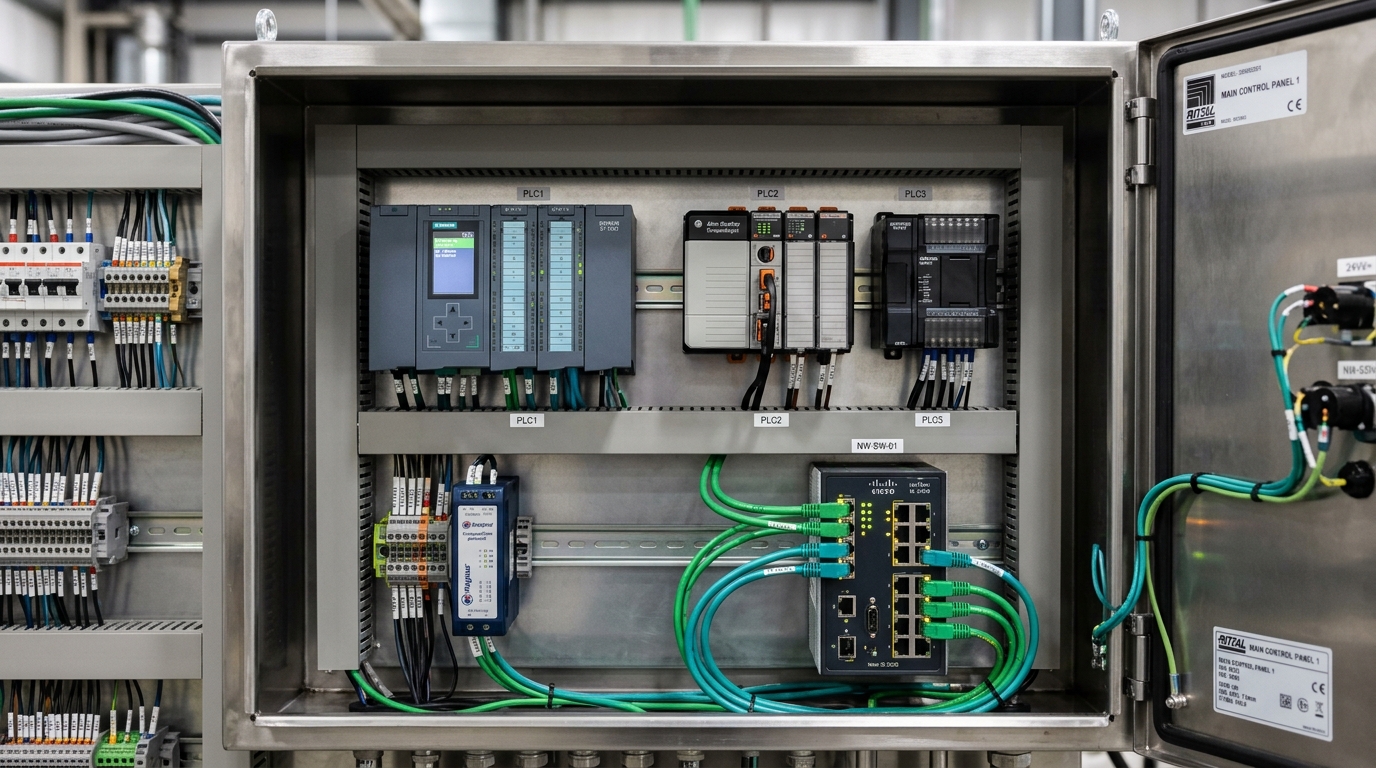
The Multi-Protocol Reality: Comparing Industrial Fieldbuses
Industrial Ethernet protocols are not interchangeable. While they all utilize standard IEEE 802.3 Ethernet physical cabling (Cat5e/Cat6a) and RJ45 or M12 connectors, their internal protocol stacks, transmission mechanisms, and determinism layers operate on fundamentally incompatible engineering principles:
| Protocol | Governing Body | Dominant Vendor | Communication Architecture | Cycle Time Performance |
|---|---|---|---|---|
| PROFINET IO | PI (PROFIBUS & PROFINET International) | Siemens S7, Phoenix Contact | Provider/Consumer model; Slot/Subslot addressing; EtherType 0x8892 bypasses TCP/IP stack for real-time cyclic I/O. | 1ms to 10ms (RT) < 250μs (IRT) |
| EtherNet/IP | ODVA (Open DeviceNet Vendors Assoc.) | Rockwell Automation, Omron | Producer/Consumer model; Common Industrial Protocol (CIP); Class 1 implicit cyclic I/O over UDP (port 2222); Class 3 explicit over TCP (port 44818). | 2ms to 20ms (RPI) Jitter mitigated via CIP Sync |
| EtherCAT | ETG (EtherCAT Technology Group) | Beckhoff, Omron Sysmac, Delta | Master/Slave processing-on-the-fly; slave ASIC chips extract and insert data into a single passing Ethernet frame; Distributed Clocks (DC). | < 100μs cycle time < 1μs jitter synchronization |
| Modbus TCP | Modbus Organization | Schneider Electric, Universal | Client/Server polling architecture; standard TCP/IP port 502; simple memory register maps (Holding Registers, Inputs, Coils). | 20ms to 200ms Non-deterministic polling |
Why Standard IT Network Switches Fail with Mixed Protocols
In an unmanaged network switch, EtherNet/IP multicast traffic (such as default CIP Producer/Consumer I/O packets) floods every connected port. When a high-traffic Rockwell line is plugged into the same unmanaged switch as a Siemens PROFINET network, the PROFINET controller ports become choked with unwanted multicast packets, causing erratic PROFINET watchdog timeouts and nuisance line trips. Multi-vendor networks strictly require Managed Industrial Switches with IGMP Snooping enabled and VLAN isolation.
The Endianness Problem: Big-Endian vs Little-Endian Architecture
When connecting a Siemens S7 controller to an Allen-Bradley ControlLogix or Omron Sysmac system, the primary cause of corrupted telemetry and erroneous sensor readings is microprocessor Endianness:
Big-Endian (Motorola Format)
Siemens stores the Most Significant Byte (MSB) at the lowest memory address. If a 16-bit word contains the hexadecimal value 0x1234, Siemens stores 0x12 in Byte 0 and 0x34 in Byte 1.
Little-Endian (Intel Format)
Rockwell Logix and Omron Sysmac store the Least Significant Byte (LSB) at the lowest memory address. The same value 0x1234 is stored as 0x34 in Byte 0 and 0x12 in Byte 1.
What Happens to 32-Bit Floating Point Numbers (IEEE 754)?
If a 32-bit REAL floating point number representing a process value (e.g., vessel temperature of 50.0 °C, represented in hex as 0x42480000) is sent raw from Siemens to Rockwell without byte restructuring:
The Engineering Solution: Byte-Swapping Implementation
Engineers resolve endianness using two distinct approaches:
- Gateway Hardware Mapping: Modern gateways (Anybus Communicator, ProSoft) feature built-in byte-swap functions within their configuration software. Enable "Swap Words" or "Swap Bytes" in the I/O mapping table, resolving endianness before packets reach the PLC memory.
- PLC Logic Refactoring: In Siemens TIA Portal SCL, apply the native
SWAP()instruction for 16-bit integers, or rotate double-words using structured bit slicing before writing to the communication buffer.
Hardware Protocol Gateways vs Software OPC UA Bridges
Selecting the correct integration mechanism depends on the required cyclic update rate, system determinism, and data structure complexity:
| Integration Architecture | Typical Update Rate | Determinism Grade | CPU Overhead Impact | Best Applied For |
|---|---|---|---|---|
| Hardware Dual-Sided Gateway (Anybus / ProSoft) | 2ms to 10ms | Hard Real-Time (Deterministic) | Zero CPU Load (Direct DMA I/O) | High-speed inter-machine interlocks, conveyor transfer handshakes, E-stop propagation. |
| OPC UA Client / Server (IEC 62541) | 100ms to 500ms | Non-Deterministic (TCP-based) | Medium to High (Stack processing) | SCADA / MES recipe transfers, OEE telemetry logging, cross-plant batch coordination. |
| Modbus TCP Client/Server (Port 502) | 50ms to 200ms | Soft Real-Time (Polling jitter) | Low (Simple memory register read/write) | Utility monitoring (energy meters, chillers, compressor sequencing) where speed is not critical. |
| Hardwired 24V DC Digital I/O Handshakes | 10ms to 30ms | Hard Real-Time (Physical voltage) | Zero CPU Load (Digital input scan) | Simple binary handshakes (Upstream Ready, Downstream Requesting, Fault Out) on simple lines. |
Network Address Translation (NAT) & IP Subnet Isolation
One of the most frequent commissioning disasters in UK industrial automation occurs when integrating pre-built machinery skids:
The OEM Skid IP Address Collision Nightmare
Machine builders build standardized machines with hardcoded IP addresses. A German filling machine arrives with its S7-1500 PLC set to 192.168.1.10. A Swiss cartoning machine arrives with its Allen-Bradley PLC also set to 192.168.1.10. An Italian labeller arrives with an Omron PLC at 192.168.1.10. Connecting all three machines to the plant-wide production Ethernet triggers immediate duplicate IP fault locks across all controllers.
The 1:1 NAT Router Solution
Rather than forcing OEMs to modify thousands of lines of code, drive addresses, and HMI tag links, systems integrators deploy industrial 1:1 NAT (Network Address Translation) routers (such as the Siemens SCALANCE S615 or Moxa NAT-102):
- Filler PLC: Local 192.168.1.10 → NAT mapped to Plant IP: 10.50.12.10
- Cartoner PLC: Local 192.168.1.10 → NAT mapped to Plant IP: 10.50.12.20
- Labeller PLC: Local 192.168.1.10 → NAT mapped to Plant IP: 10.50.12.30
Every OEM machine preserves its factory-default internal IP architecture, while the plant SCADA system communicates with clean, unique IP addresses on the plant subnet.
Vendor-Neutral Field Device Integration with IO-Link
Historically, choosing a PLC brand forced plant managers to purchase proprietary field instrumentation (e.g., Siemens ET200 I/O modules or Rockwell Point I/O slices). IO-Link (IEC 61131-9) has revolutionized modern control panel engineering by breaking vendor lock-in at the sensor level:
Decoupling Sensors from Proprietary PLCs
Machine builders specify IP67 machine-mounted IO-Link master hubs (from vendor-neutral manufacturers such as ifm electronic, Balluff, or Turck). Standard 3-wire unshielded M12 sensor cables connect to laser distance meters, pressure transmitters, RFID heads, and pneumatic valve terminals:
For a Siemens Specification
Order the IO-Link master with a PROFINET interface. Plug the M12 D-coded Ethernet cable directly into the S7-1500 network. The field sensors remain identical.
For a Rockwell Specification
Order the identical IO-Link master with an EtherNet/IP interface. Plug into the CompactLogix network. 100% of the mechanical mounting, sensor brackets, and field wiring remain completely unchanged.
Bridging Safety Networks: PROFIsafe to CIP Safety
When a plant links a Siemens-controlled packaging cell with an Allen-Bradley robotic palletiser, functional safety compliance under BS EN ISO 13849-1 and PUWER 1998 requires cross-cell emergency stop and guard interlock propagation:
Can You Bridge Safety Protocols Directly in Software?
No standard Ethernet gateway can route safety signals between PROFIsafe and CIP Safety. Under functional safety law, passing safety data through an uncertified bridge invalidates the safety loop, collapsing the Performance Level to unrated (Cat B). Engineers must choose between two certified architectures:
Method 1: Certified Safety Gateway (SIL 3)
Deploy specialized safety gateways (e.g., Hilscher netTAP or Anybus Safety). These devices implement Black Channel safety stacks on both sides, allowing up to 16 bytes of safe digital I/O exchange while maintaining TÜV certification to PL e / SIL 3.
Method 2: Hardwired Relay Cross-Coupling
For simple cross-cell trips (E-Stop and Guard Gate), wire dual-channel 24V DC fail-safe digital outputs (F-DO) from the Siemens panel into dual-channel fail-safe inputs (F-DI) on the Rockwell panel using force-guided interposing relays. This method is 100% audit-proof, extremely reliable, and easy for site technicians to troubleshoot.
Frequently Asked Questions (Multi-Vendor PLC Integration)
Click any question below to explore technical answers regarding PROFINET and EtherNet/IP bridging, protocol gateways, and endianness resolution.
Q1:What is the most reliable hardware method to exchange data between Siemens PROFINET and Allen-Bradley EtherNet/IP?
Q2:How do you solve the Big-Endian versus Little-Endian byte order mismatch between Siemens and Rockwell PLCs?
Q3:Can safety interlocks be bridged between a Siemens PROFIsafe system and an Allen-Bradley CIP Safety network?
Q4:How do Network Address Translation (NAT) routers prevent IP address conflicts on multi-vendor factory lines?
Q5:When should OPC UA be chosen over a hardware fieldbus gateway for multi-vendor PLC communication?
Q6:How does IO-Link eliminate vendor lock-in for field sensors and valve manifolds?
Seamless Multi-Vendor Integration with MASK Controls
Whether linking Siemens S7-1500, Allen-Bradley ControlLogix, Omron Sysmac, or legacy platforms across your UK factory floor, MASK Control Systems delivers robust, turnkey systems integration and protocol bridging engineering.
Need Multi-Platform PLC Systems Integration Support?
Speak directly with our senior systems integration engineers in Devon. We design, program, commission, and bridge heterogeneous industrial networks across the UK.