
Data Centre Emergency Power & ATS Synchronization Automation: Generator Paralleling, G99 & EPMS Systems
Mission-critical emergency power automation engineered for UK hyperscale, colocation, and enterprise data centres. MASK designs and commissions multi-generator paralleling switchgear, closed-transition automatic transfer switches (ATS make-before-break), ENA EREC G99 grid-tie synchronization, automated block load shedding, and sub-cycle EPMS disturbance recording.
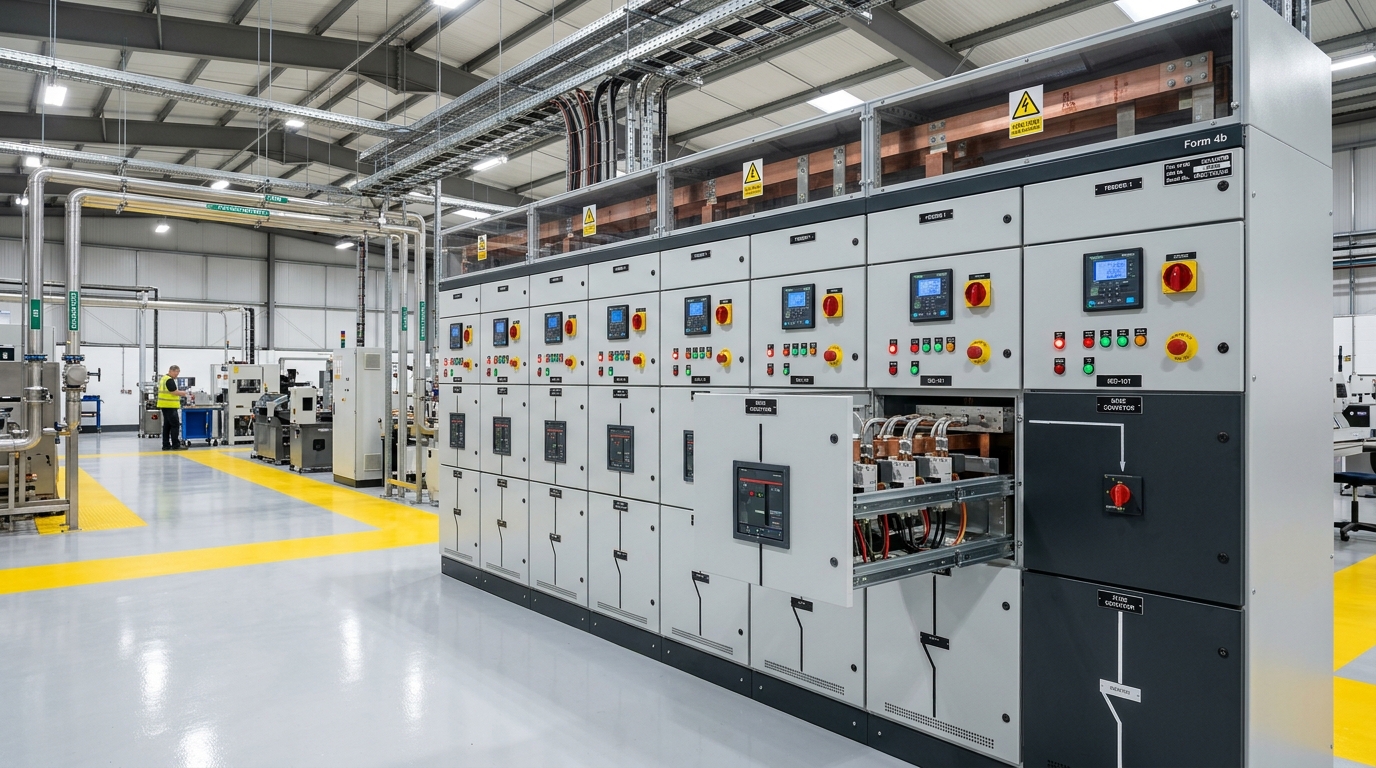
Grid Vulnerability, Block Load Stalls & Transfer Transient Risks
When a utility grid outage strikes a 20 MW to 100 MW data centre campus, the electrical switchgear must react instantly. Standby generator sets must start, synchronize to the common bus, and take over the building load within seconds without frequency dips, reverse power trips, or out-of-phase breaker closures. A split-second failure during transfer compromises downstream UPS batteries, trips chiller plant compressors, and exposes IT workloads to catastrophic dropouts.
Block Load Frequency Stalls
Stepping full chiller and UPS rectifier loads onto cold engines in a single step causes severe turbocharger lag and engine speed drops below 47.5 Hz. Under-frequency relays trip the generator offline, causing cascading power failure across the entire critical bus.
Open-Transition Voltage Sags & Inrush
Conventional break-before-make ATS switches disconnect inductive loads for hundreds of milliseconds. When power is reconnected, out-of-phase residual magnetic fields generate destructive inrush currents up to 20x nominal, tripping upstream breakers and degrading transformers.
Degraded Diesel Fuel & Day Tank Failures
Generators sitting idle for months accumulate microbial growth, water condensation, and asphaltene sludge in bulk fuel tanks. When an extended outage demands 24-hour continuous running, fuel injectors foul or transfer pumps fail, stalling generators under peak IT load.
Basic Standalone Packaged Generator Controls vs MASK Engineered Paralleling Architecture
How our integrated industrial switchgear automation delivers Tier III / IV concurrent maintainability.
| System Characteristic | Basic OEM Packaged Generator Panel | MASK Engineered Paralleling Switchgear Architecture |
|---|---|---|
| Paralleling & Synchronization | Single generator per ATS. No bus paralleling or N+1 capacity sharing. | Multi-generator digital load controllers (Woodward/ComAp/Deif) with active kW/kVAR sharing. |
| Transfer Mode to Grid | Open-transition (break-before-make). Power interruption cycles UPS batteries during tests. | Closed-transition (make-before-break, <100ms overlap). Seamless monthly testing with zero disruption. |
| Dead-Bus Closing Interlock | Hardwired timer relays prone to welded contacts and out-of-phase bus closing. | Deterministic first-up digital arbitration logic with hardware and software synch-check cross-checks. |
| Load Shedding / Step Loading | All loads connected at once. High risk of generator stall during cold block loads. | Programmable multi-stage priority shedding via redundant PLCs; mechanical loads staged safely. |
| UK Grid Compliance | Basic over-current relays. Non-compliant with DNO parallel operation rules. | Full ENA EREC G99 / G100 certified loss-of-mains (RoCoF df/dt, vector shift) and export limiting. |
| Power Quality & Diagnostics | Basic analog volt/frequency gauges. No historical fault waveform capture. | EPMS SCADA with 1024 samples/cycle transient waveform capture, trip coil health, and SOE logs. |
Five Technical Pillars of Data Centre Standby Power Automation
From high-speed generator paralleling switchgear to closed-transition transfer schemes and G99 grid interconnects, our engineering ensures fault-tolerant operation under extreme utility grid contingencies:
Multi-Generator Paralleling Switchgear & Isochronous Load Sharing
Paralleling multiple 2 MVA to 3.5 MVA generator sets requires sub-cycle synchronization and active load balancing. MASK integrates multi-unit digital paralleling controllers (Woodward Easygen, ComAp InteliGen, or Deif AGC-4) coordinated with fail-safe PLC switchgear. Generators execute deterministic dead-bus arbitration, synchronizing and sharing real (kW) and reactive (kVAR) load isochronously without hunting or circulating currents.
Closed-Transition Automatic Transfer Switches (Make-Before-Break)
Executing monthly emergency generator runs on open-transition switches forces the entire data centre onto battery power twice per test, increasing battery degradation and risking dropped loads. MASK engineers closed-transition ATS controls that synchronize generator output with the live utility supply. Sources overlap for under 100 milliseconds with soft power ramping, ensuring transparent load transfer with zero electrical disturbance.
ENA EREC G99 / G100 Mains Protection & Grid Interconnection Automation
Operating standby generation in parallel with the UK electrical network (for test runs, peak lopping, or Demand Side Response) mandates full compliance with Energy Networks Association (ENA) EREC G99 and G100 regulations. MASK engineers G99 protection cubicles equipped with multi-function loss-of-mains (RoCoF df/dt and vector shift) relays, reverse power monitoring, and DNO-witnessed commissioning documentation.
Priority Load Shedding, Block Loading & Tie-Breaker Sequencing
Cold generator engines cannot accept 100% building load in a single step without severe frequency instability. MASK programs intelligent load-shedding and step-loading routines inside redundant PLCs. Non-critical mechanical infrastructure (chiller plants, office HVAC, battery chargers) is shed automatically, allowing essential UPS rectifiers to stabilize on generator power before mechanical stages are sequentially restored.
EPMS SCADA Integration, Waveform Disturbance & Fuel Polishing
Electrical Power Management Systems (EPMS) provide real-time visibility into switchgear status and power quality. MASK deploys high-speed power quality meters capturing voltage transients up to 1024 samples per cycle, logging breaker operating times, trip coil continuity, and harmonic distortion. Concurrently, automated fuel management panels control day-tank polishing skids and transfer pumps, preventing injector fouling.
Isolated Standby vs Paralleled Multi-Gen vs Grid-Interactive DSR
Depending on mission criticality, facility megawatt scale, and utility grid constraints, data centres implement distinct standby architectures. Here is how MASK engineers automation across all three configurations:
| Specification Parameter | Isolated Standby Generation | Paralleled Multi-Gen Switchgear | Grid-Interactive DSR / Peak Lopping |
|---|---|---|---|
| Start & Synchronization Time | 10 to 15 seconds to single load bus | 10 to 12 seconds; all sets paralleled to common bus | Scheduled ramp-up; 30 to 60 seconds soft synch to live grid |
| Mains Transition Mode | Open-transition (break-before-make); 50-500 ms outage | Closed-transition (make-before-break); <100 ms zero-dropout overlap | Continuous parallel operation; base-load export or zero-export limit |
| Grid Compliance Standard | Basic connection agreement; no parallel feed | ENA EREC G99 (Short-Term Parallel for Testing) | Full ENA EREC G99 / G100 Export Limitation Scheme with DNO witnessed tests |
| Load Shedding Capability | Single-stage emergency trip via shunt trip breaker | Multi-stage block loading and dynamic under-frequency priority shed | Automated capacity market dispatch with target import/export kW regulation |
| Typical MASK Platform | ComAp InteliLite + Schneider Compact NSX circuit breakers | Woodward Easygen 3500XT + Rockwell GuardLogix PLC + Masterpact MTZ ACBs | Deif AGC-4 / Woodward + Siemens S7-1500R Redundant PLC + SEL-751 relays |
Engineered with Industry-Standard Emergency Power Platforms
We engineer control systems complying with BS EN 61439 Form 4 Type 6/7, deployed on the hardware platforms specified by leading hyperscale and colocation operators:
Woodward & ComAp Gen Controls
Woodward Easygen 3500XT and ComAp InteliGen controllers with isochronous kW/kVAR load sharing lines, dead-bus arbitration, and G99 loss-of-mains protection.
Explore Control Panel DesignRockwell ControlLogix Redundancy
ControlLogix 5580 redundant processor pairs with Device Level Ring (DLR) I/O, automated load shedding logic, and Masterpact MTZ air circuit breaker coordination.
Explore Allen-Bradley ServicesSiemens S7-1500R & SIPROTEC
SIMATIC S7-1500R redundant controllers integrated with SIPROTEC 5 protection relays via IEC 61850 for ultra-fast busbar differential and reverse power tripping.
Explore Siemens ServicesOur 5-Stage Emergency Power Commissioning Methodology
Commissioning emergency power systems for mission-critical facilities requires rigorous stage-gate progression:
Protection Coordination Study
Short-circuit calculations, grading curves, breaker trip settings to BS EN 61439, and ENA EREC G99 loss-of-mains study.
Form 4 Switchboard Build
Bespoke Form 4 Type 6/7 segregated enclosures, copper busbars up to 100kA, and in-house FAT staging with simulated load controllers.
Cold Wiring & Point-to-Point
On-site secondary injection testing, CT/VT polarity checks, breaker auxiliary contact wiring, and fiber network ring continuity.
Load Bank Step Testing
Resistive/reactive load bank testing from 25% to 110% load, turbo transient response checks, and automated block loading tuning.
Black Building Test & Handover
Full utility power cut simulation, closed-transition ATS return, DNO G99 witness testing sign-off, and final O&M manuals handover.
Emergency Power Automation Questions Answered
Technical guidance on closed-transition ATS, multi-generator paralleling, and ENA G99 grid compliance.
How does closed-transition ATS transfer differ from standard open-transition transfer?
How do your control systems prevent generator tripping during sudden block loading?
What protection relays and G99 grid compliance testing are required for mains paralleling in the UK?
How is dead-bus closing safely coordinated between multiple paralleled generators?
What diagnostic parameters does the EPMS SCADA track on medium- and low-voltage air circuit breakers (ACBs)?
Can MASK automate fuel polishing and day-tank replenishment skids?
Explore More Critical Utilities & Infrastructure
Discover our specialized control architectures across water utilities, energy storage, and industrial cooling:
Water & Utilities Automation
WIMES 3.01 Form 4 MCCs, telemetry RTUs, pumping stations, and critical process water automation architectures.
Data Centre Chiller Plants
Dual-redundant hot-standby PLCs, variable primary chiller sequencing, water-side free cooling economizers, and CRAH controls.
BESS Battery Storage SCADA
Turnkey BESS master control panels, G99 grid compliance, container liquid chiller loops, and DNP3/IEC 61850 substation gateways.
SCCR Fault Level Guide
Short-circuit current rating (SCCR) calculations, busbar withstand ratings, and protective device coordination to BS EN 61439.
Protect Critical Uptime with Turnkey Standby Power Switchgear Automation
Whether designing a new hyperscale generator paralleling scheme, upgrading legacy open-transition ATS panels to closed-transition soft loading, or achieving ENA EREC G99 grid compliance, MASK delivers mission-critical electrical engineering backed by over 20 years of UK control systems experience.