
Specialty Chemicals & Batch Reactor Automation: ISA-88 Batch Control, ATEX Zone 1 Panels & SIL 2/3 SIS
Turnkey process automation architectures engineered for UK specialty chemical, active pharmaceutical ingredient (API), and fine chemical synthesis facilities. MASK designs and commissions modular ISA-88 recipe execution systems, ATEX Zone 1/21 explosion-proof control panels, dual-loop cascade reactor temperature regulation, and SIL 2/3 exothermic runaway prevention systems.
Volatile Reagents, Exothermic Runaways & Batch-to-Batch Variance
Batch synthesis plants operate under intense chemical kinetics and hazardous atmospheres. Highly exothermic polymerisations, nitrations, alkylations, and active pharmaceutical ingredient (API) syntheses involve flammable solvents, toxic intermediates, and high-pressure reactions. A single thermal runaway can destroy equipment or cause catastrophic vapor cloud releases. Operators require deterministic automation that protects personnel while ensuring strict batch consistency.
Exothermic Runaway Catastrophes
When heat generation from reaction kinetics outpaces jacket cooling capacity, vessel temperatures and pressures escalate exponentially within seconds. Without an autonomous, SIL-rated safety instrumented system to inject quench chemicals or dump feeds, reactor rupture is imminent.
ATEX Non-Compliance & Spark Ignition
Processing volatile solvents (toluene, acetone, methanol) creates hazardous Zone 1 / Zone 21 explosive atmospheres. Inadequately sealed control panels, improper cable glands, or unisolated instrumentation risk catastrophic spark ignition, triggering severe HSE DSEAR prohibition notices.
Off-Spec Batches & Yield Losses
Manual chemical addition, erratic jacket heating transitions, and operator timing errors cause wide batch-to-batch yield variations and high impurity profiles. In high-value specialty synthesis, discarding a single ruined 5,000-litre batch can cost £50,000 to £250,000 in raw material losses.
Manual / Hardwired Skid Setup vs MASK Engineered ISA-88 Batch Architecture
Comparing outdated manual reactor operations with our automated ISA-88 modular batch control platform.
| System Characteristic | Legacy / Manual Chemical Reactor | MASK Engineered ISA-88 Batch Architecture |
|---|---|---|
| Recipe Execution | Operators manually open valves following paper batch sheets. High human error. | Standardized ISA-88 modular procedural states (Charge, Heat, React, Cool, Transfer) with automated phase logic. |
| Hazardous Area Design | Standard industrial panels placed in hazardous areas with uncertified glands. | Certified ATEX Zone 1/21 Ex d flameproof, Ex p purge, and Ex i galvanic isolation to BS EN 60079. |
| Reactor Temperature Loop | Single-loop manual PID. Massive thermal lag and dangerous overshoot spikes. | Dual-loop cascade PID (product master / jacket slave) with dynamic anti-windup and split-range heating/cooling. |
| Runaway Safeguarding | Operator manual e-stop button and mechanical burst disc only. Sluggish response. | Independent SIL 2 / SIL 3 Safety Instrumented System (SIS) with automated quench and nitrogen blanketing. |
| Chemical Feed Accuracy | Sight glass estimations or simple magnetic flow meters. ±3% to ±5% error. | Closed-loop Coriolis mass flow metering with variable-speed metering pumps (±0.1% stoichiometric accuracy). |
| Audit Trail & Traceability | Paper logbooks prone to missing signatures and incomplete temperature charts. | 21 CFR Part 11 compliant Electronic Batch Records (EBR), encrypted digital signatures, and GAMP 5 audit logs. |
Five Engineering Pillars of Batch Reactor & Chemical Automation
From high-accuracy stoichiometric reactant dosing to SIL 3 safety instrumented functions and hazardous area control panels, our systems guarantee process precision and regulatory compliance:
ISA-88 (S88) Modular Batch Recipe Architecture & Electronic Batch Records
We structure chemical process control strictly to the ANSI/ISA-88 standard (IEC 61512), decoupling the physical equipment hierarchy from procedural batch logic. Process engineers can configure Master Recipes, unit procedures, and phases (Charge, Heat, Hold, Reflux, Distil, Cool, Transfer, CIP) via graphical recipe authoring suites. Built-in electronic batch records (EBR), audit trails, and electronic signatures comply fully with 21 CFR Part 11 and GAMP 5.
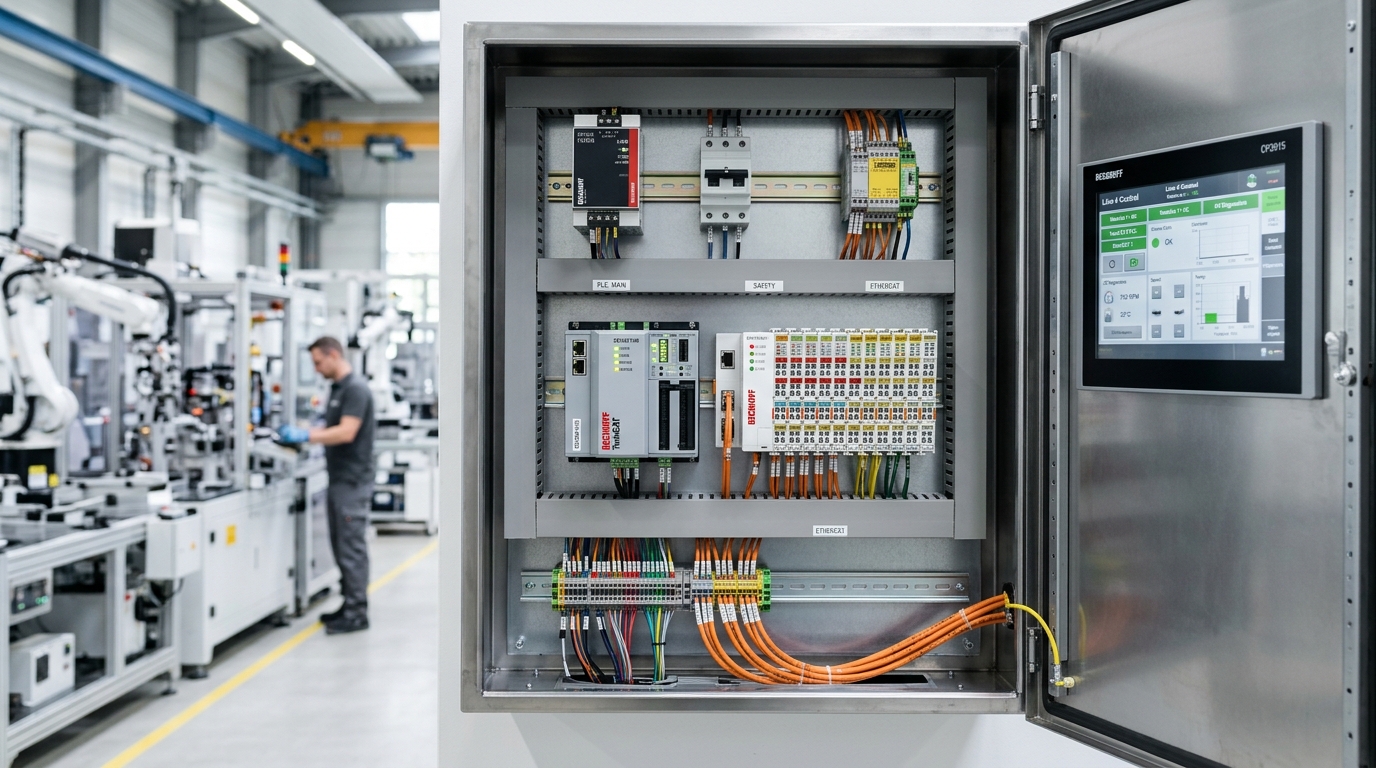
ATEX Zone 1 & Zone 21 Ex d, Ex p & Ex i Hazardous Area Control Panels
Operating in flammable solvent and combustible powder environments mandates compliance with DSEAR and the ATEX Directive. MASK designs, fabricates, and certifies bespoke control panels utilizing Flameproof (Ex d) cast enclosures, Pressurized/Purged (Ex p) continuous inert gas overpressure systems, and Intrinsically Safe (Ex i) galvanic isolators for field sensors and 4-20mA HART valve positioners in Zone 0/1/20/21.
Jacketed Reactor Cascade PID Temperature & Cryogenic Cooling Loops
Reactor core temperature stability is critical for selectivity and yield. MASK implements dual-loop cascade control architectures where the product temperature PID controller dynamically recalculates the setpoint for the fast-acting jacket fluid temperature loop. Our systems smoothly coordinate high-pressure steam, tempered hot water, chilled glycol (-20°C), and cryogenic liquid nitrogen (-80°C) with split-range valve throttling and anti-windup protection.
SIL 2 / SIL 3 Safety Instrumented Systems (SIS) & Exothermic Runaway Safeguards
Protecting process vessels from catastrophic thermal runaway requires safety controls that operate independently of the basic process control system (BPCS). We design and validate certified Safety Instrumented Functions (SIF) to BS EN 61508 and BS EN 61511. Utilizing 1oo2 or 2oo3 voting across dual/triple redundant temperature and pressure sensors, the SIS executes automated solvent quench dumps, nitrogen inerting, and reactant feed cut-offs.
Coriolis Mass Flow Dosing & Solvent Recovery Distillation Skids
Maximising chemical conversion efficiency requires precision reactant stoichiometry and efficient downstream solvent purification. MASK integrates high-accuracy Coriolis mass flow meters, variable-speed magnetic-drive dosing pumps, and automated vacuum distillation columns. Our control algorithms calculate real-time reflux ratios, column differential pressures, and condensation temperatures to recover valuable solvents up to 99% purity.
Manual Skid vs Semiautomated PLC vs Fully Integrated ISA-88 SIS
Evaluating the progression from basic relay-based manual reactor vessels to an enterprise-integrated ISA-88 automated synthesis facility:
| Specification Parameter | Manual Chemical Skid | Semiautomated Packaged PLC | MASK Full ISA-88 + SIL 2/3 SIS Architecture |
|---|---|---|---|
| Recipe Execution Flexibility | Paper batch sheets; manual operator valve positioning | Hardcoded step sequences; requires PLC reprogramming to adjust | Modular S88 recipe authoring; dynamic phase parameter adjustment without revalidation |
| Hazardous Area Safety | Non-certified equipment with remote pushbuttons | Standard Ex d enclosure with limited local display instrumentation | Full Zone 1/21 Ex d/p panels, intrinsically safe Ex i barriers, ATEX touchscreen HMIs |
| Thermal Runaway Safeguard | Rupture disc burst relief and manual operator fire hose quench | Single software alarm on high temperature; no independent shutdown | Independent SIL 2 / SIL 3 Safety Instrumented System (SIS) with automated cold solvent dump |
| Reactant Addition Control | Drum tipping or manual pump timing; high variance | Totalizing magnetic flow meter with manual valve stop | Closed-loop Coriolis mass flow metering with variable-speed metering pumps (±0.1% accuracy) |
| Regulatory Data Integrity | Handwritten paper logbooks; vulnerable to audit findings | Local HMI alarm history; manual CSV exports | 21 CFR Part 11 Electronic Batch Records (EBR), encrypted digital signatures, GAMP 5 logs |
Engineered with Industry-Standard Chemical Automation Systems
We engineer control systems complying with BS EN 60079 and BS EN 61511, deployed on the hardware platforms specified by global chemical and pharmaceutical producers:
Rockwell FactoryTalk Batch
GuardLogix 5580 safety controllers paired with FactoryTalk Batch, Point Guard I/O, and intrinsically safe 1734-IB8S modules for SIL 2/3 reaction safeguarding.
Explore Allen-Bradley ServicesSiemens SIMATIC BATCH & PCS 7
S7-1500F fail-safe CPUs or PCS 7 / PCS neo systems with ET 200SP HA intrinsically safe Ex i I/O modules, PROFINET redundancy, and SIMATIC BATCH recipe control.
Explore Siemens ServicesEmerson DeltaV & SIS
DeltaV Batch execution with integrated Electronic Marshalling (CHARMs), SIL 3 safety instrumented systems, and HART-enabled diagnostic valve positioners.
Systems Integration ServicesOur 5-Stage Chemical Process Engineering Methodology
Commissioning hazardous chemical reaction facilities requires strict adherence to functional safety and validation standards:
HAZOP & LOPA Safety Review
Hazard and Operability (HAZOP) analysis, Layer of Protection Analysis (LOPA) to assign SIL targets, and DSEAR hazardous area zoning.
ATEX Panel Build & FAT
In-house manufacture of Ex d, Ex p, or Ex i control panels to BS EN 60079, complete with pressure decay testing and factory acceptance testing.
ISA-88 Batch Software Coding
Modular phase logic development, cascade PID thermal modeling, 21 CFR Part 11 audit logging, and SIL-rated emergency shutdown logic.
Loop Checks & Water Batches
On-site IS barrier inspection, Coriolis mass meter calibration, cascade PID thermal tuning with safe solvent/water batches, and SIF trip validation.
Live Chemical Start-Up & Handover
Live chemical reaction introduction, stoichiometric verification, solvent recovery optimization, GAMP 5 documentation, and final sign-off.
Chemical Batch Reactor Automation Questions Answered
Detailed technical guidance on ISA-88 modular batch control, cascade reactor loops, and ATEX explosion protection.
What is the difference between an ISA-88 modular batch control system and conventional PLC sequencing?
How does cascade PID temperature control prevent thermal overshoot in jacketed reactors?
What explosion protection concepts (Ex d, Ex e, Ex p, Ex i) are used in Zone 1 chemical plants?
How does a SIL 2 or SIL 3 Safety Instrumented System (SIS) protect against exothermic runaway?
How do Coriolis mass flow meters improve stoichiometric dosing accuracy?
How does MASK ensure electronic batch record compliance with 21 CFR Part 11 and GAMP 5?
Explore More Life Sciences & Hazardous Process Solutions
Discover our specialized control architectures across pharmaceutical cleanrooms, hazardous areas, and hygienic distillation:
Pharmaceutical & Medical
GMP-compliant PLC programming, cleanroom HVAC controls, 21 CFR Part 11 audit trails, and validation support.
ATEX & DSEAR Panel Guide
Comprehensive design principles for Ex d flameproof, Ex p purge, and Ex i intrinsic safety in Zone 1/21 environments.
Craft Brewing & Distilling
Reflux column automation, spirit cuts, fermentation cellar temperature regulation, and clean-in-place skids.
Safety PLC vs Safety Relay
Functional safety engineering guide covering SIL ratings, Cat 4 PLe architectures, and proof test calculations.
Modernise Your Chemical Synthesis with Modular ISA-88 Automation
Whether designing a new ATEX Zone 1 jacketed batch reactor suite, upgrading legacy controllers to ISA-88 modular batch recipes, or validating a SIL 2/3 exothermic runaway safety system, MASK delivers process automation backed by over 20 years of UK industrial experience.