The Obsolescence Trap: The True Cost of Delaying a PLC Upgrade
Across manufacturing plants in the United Kingdom and Europe, thousands of production lines continue to rely on programmable logic controllers designed and commissioned in the 1990s and early 2000s. Common workhorses like the Siemens SIMATIC S5, Siemens S7-300, Allen-Bradley SLC 500, PLC-5, and Omron C200H have served factories reliably for decades. Because these machines still cycle each morning, plant management frequently operates under the perilous assumption: "If it is not broken, do not touch it."
However, in industrial automation, obsolescence is not a slow degradation. It is a binary event. The original manufacturers of these systems ceased production years ago. Key microchips, optocouplers, and power supply transformers are no longer fabricated. When an obsolete CPU module or analog input card fails today, plant managers face an emergency scenario characterized by three critical failure modes:
Replacement parts must be sourced from unauthorized brokers or auction sites at 5x to 10x original list price, with zero calibration certificates or functional warranties.
Legacy CPUs depend on 3.6V lithium coin batteries to preserve RAM memory. When the battery depletes during a scheduled weekend power shutdown, the entire program code is erased permanently.
Legacy programming tools (STEP 5, RSLogix 5, Syswin) will not run on modern 64-bit Windows operating systems, requiring obsolete laptops with physical RS-232 serial COM ports.
In high-throughput sectors like food manufacturing, pharmaceuticals, and automotive assembly, unplanned downtime routinely costs between £8,000 and £45,000 per hour. Waiting for a legacy failure to force an emergency retrofit turns a controlled, scheduled engineering modernization into an expensive crisis.
Legacy PLC Platforms and Their Modern Engineering Targets
Modernizing a legacy system requires selecting an equivalent target architecture that satisfies cycle time requirements, communications bandwidth, and physical cabinet footprint. Below are the verified modernization paths our engineering specialists deploy across the UK:
Siemens SIMATIC S5 (95U, 100U, 115U, 135U)
Siemens SIMATIC S7-300 & S7-400
Allen-Bradley SLC 500 & MicroLogix
Allen-Bradley PLC-5 (1771 Chassis)
Omron C200H, C200HG, CQM1 & CVM1
Schneider Modicon TSX Premium / Quantum
Mitsubishi MELSEC-A, AnS & FX2N
Multi-Vendor Flexibility: We also engineer agile cross-platform migrations. For budget-conscious retrofits requiring open Linux edge computing or compact servo integration, we routinely transition legacy racks to modern Delta Automation AS Series or Phoenix Contact PLCnext architectures.
The Three Migration Methodologies: Choosing the Right Strategy
No two production lines have identical shutdown tolerances. A continuous pharmaceutical cleanroom cannot tolerate more than 12 hours of downtime, whereas a single-shift engineering workshop may have an entire Christmas shutdown window. We deploy three proven migration methodologies based on operational risk:
1Phased I/O Retention via Industrial Gateways
In this low-risk approach, the legacy CPU is upgraded first while the existing physical I/O chassis (such as 1771 racks or ET 200M drops) are retained in place. Industrial protocol gateways (e.g., Anybus, ProSoft, or Siemens DP/PN Couplers) bridge the modern controller with legacy fieldbuses. Once the new CPU is proven in production, remote I/O drops are replaced module-by-module during future scheduled maintenance windows.
2Pre-Wired Swing-Arm Conversion Harnesses (Zero Re-termination)
When the entire I/O rack must be modernized but rewiring hundreds of field sensors would take days, we deploy pre-engineered swing-arm wiring conversion adapters. The existing 40-pin terminal blocks are detached from the obsolete PLC and plugged directly into conversion harnesses that mate with modern high-density cards (e.g., Siemens S7-1500 or Allen-Bradley 1756). This eliminates field wire identification errors and cuts physical changeover time by up to 75 percent.
3Full Turnkey Backplate Re-engineering (Complete Modernization)
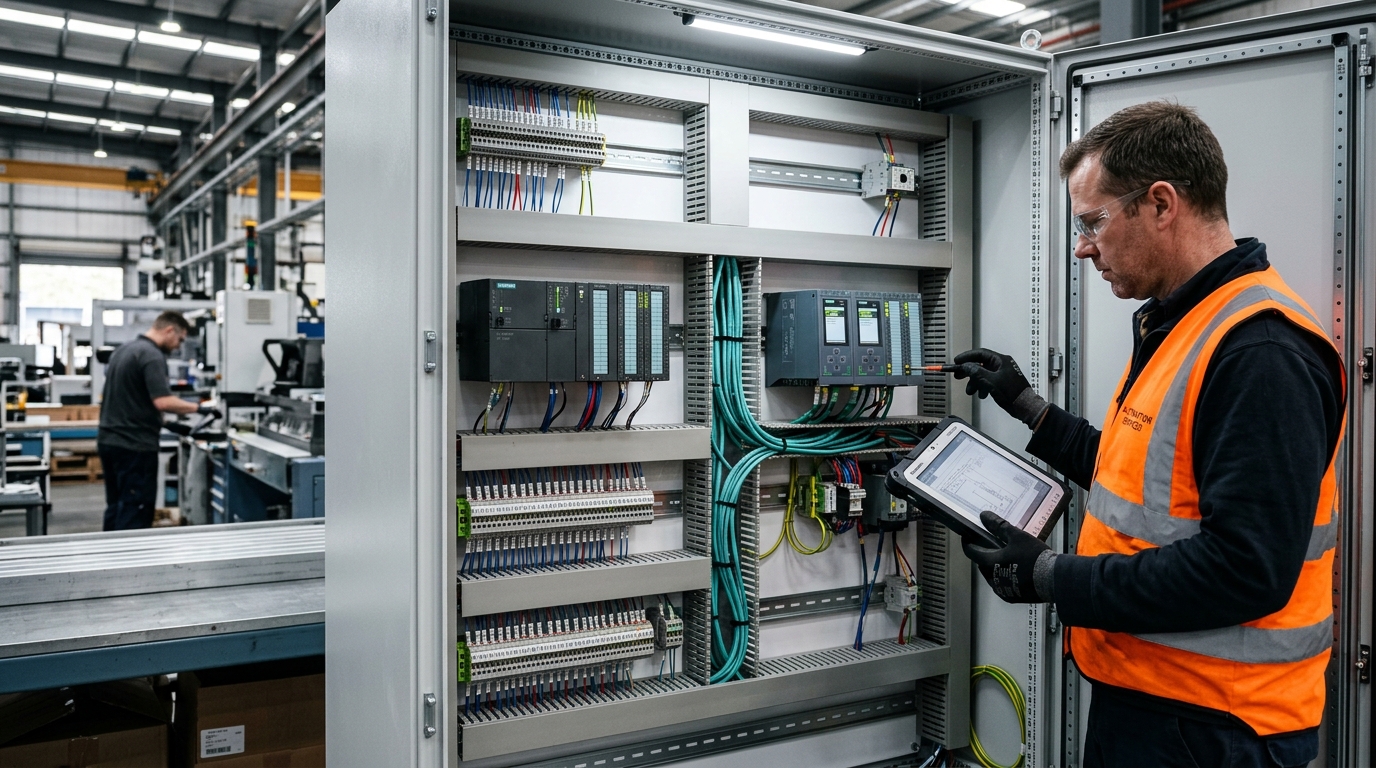
For machines undergoing a comprehensive electrical overhaul, we design, fabricate, and test an entirely new internal sub-panel backplate in our control panel manufacturing facility. The old backplate is removed, the new pre-wired backplate is mounted, and field conduits are connected to labeled high-density Phoenix Contact terminal rails. This delivers a brand new electrical control panel meeting full BS 7671 & EN 60204-1 standards.
The 6-Step Engineering Execution Roadmap
Successful PLC migrations are 90 percent preparation and 10 percent on-site cutover. Here is our rigorous, ISO 9001 certified project methodology:
Comprehensive Code & Hardware Audit
Extracting active binary and source code, cataloguing physical I/O counts, identifying communication fieldbuses, and mapping unassigned memory tags.
IEC 61131-3 Logic Refactoring
Translating obsolete statement lists (STL) and instruction sets into modular Structured Text (ST) and Function Block Diagrams (FBD) with clean tag naming.
Hardware Engineering & Pre-Wired Conversion
Designing DIN rail layouts, selecting swing-arm I/O adapters, calculating cabinet heat dissipation, and upgrading 24V DC switch-mode power supplies.
Digital Twin & Hardware-in-the-Loop FAT
Testing 100 percent of code sequences on physical target hardware against simulated machine sensors before entering the customer facility.
Scheduled Cutover Window & Commissioning
Swapping processors during planned non-production hours, validating field sensor response, and running dry-cycle safety interlock verifications.
Handover, EPLAN As-Builts & Training
Delivering complete EPLAN electrical schematics, backed-up project archives, and training maintenance technicians on modern diagnostic suites.
Beyond Line-by-Line Translation: Why Manual Code Refactoring Matters
A common mistake made by inexperienced automation contractors is relying solely on automated code conversion tools (such as software migration wizards in TIA Portal or Studio 5000). While these tools successfully translate mnemonics, they produce code riddled with legacy technical debt:
- Direct Memory Addressing: Obsolete direct registers (like S5 Data Blocks or SLC N7:0 integers) lack context and human-readable names.
- Unstructured Jump Loops: Legacy statement list code heavily relied on conditional jump instructions (JC / JU) that break modern scan deterministic execution.
- Incompatible Timer Bases: Obsolete timers (like S5-KT timers or SLC 0.01s timebases) calculate overflow differently than modern IEC TON/TOF instructions.
Our controls engineers manually deconstruct legacy routines and refactor them into modular, object-oriented IEC 61131-3 structures. By creating custom User-Defined Data Types (UDTs) and standardized Function Blocks (FBs) for pumps, valves, servos, and conveyors, the modernized code becomes intuitive for plant technicians to troubleshoot, significantly reducing mean-time-to-repair (MTTR). Learn more about our programming standards on our PLC Programming & Software Hub.
Functional Safety Upgrades: Meeting BS EN ISO 13849-1
When a machine's primary logic controller is replaced, plant engineers have a legal duty under the Provision and Use of Work Equipment Regulations (PUWER) and the Machinery Directive to ensure safety integrity is maintained or improved.
Legacy machines frequently relied on aging electro-mechanical safety relays (e.g., Pilz PNOZ) with discrete wiring daisy-chained across decades of field modifications. During a migration, we integrate Failsafe Safety PLCs (such as Siemens S7-1500F or Allen-Bradley GuardLogix). Safety inputs (emergency stop pushbuttons, optical light curtains, RFID guard interlocks) are wired to SIL 3 / PLe rated failsafe I/O slices.
This transition eliminates cumbersome hardwired relay banks, enables instantaneous safety diagnostic reporting on the HMI, and verifies full compliance with BS EN ISO 13849-1 (Performance Level d/e) and IEC 62061 (Safety Integrity Level 2/3).
Frequently Asked Questions About PLC Migrations
How can a plant migrate an obsolete PLC without halting active production lines?
Through phased migration techniques including pre-wired swing-arm I/O conversion harnesses, parallel gateway testing, and digital twin simulation. By pre-testing all converted logic against simulated I/O and retaining existing field sensor wiring, physical cutover can be executed within a scheduled weekend shutdown.
What happens if a legacy PLC processor loses its memory during an outage?
Legacy controllers such as Siemens S5 or Allen-Bradley SLC 500 rely on internal lithium backup batteries to maintain volatile RAM memory. If the battery dies during an unpowered weekend or holiday shutdown, the entire machine program and configuration parameters are wiped, resulting in catastrophic multi-day downtime unless an identical up-to-date EPROM or memory card is on site.
Can existing field wiring and sensors be preserved during a PLC upgrade?
Yes. Modern migration hardware utilizes pre-engineered conversion brackets and terminal wiring adapters that plug directly into existing 1771, 1746, or S7-300 terminal blocks. This eliminates the need to pull new cables through conduit, reducing mechanical installation time by up to 75 percent.
How do automated code conversion utilities compare to manual logic refactoring?
Automated conversion utilities translate code line-by-line, which often duplicates obsolete timer loops, direct memory addresses, and unstructured spaghetti logic. Professional systems integrators manually refactor legacy code into IEC 61131-3 structured text and modular function blocks, ensuring high execution speed, easy diagnostics, and future-proof maintainability.
Does a PLC migration require safety circuit re-certification under UK and European law?
Yes. Modifying or replacing a machine control architecture triggers compliance reviews under BS EN ISO 13849-1 and EN 62061. Upgrading to a modern platform allows plant operators to replace obsolete hardwired safety relays with integrated failsafe safety PLCs (such as PROFIsafe or CIP Safety), elevating system safety integrity to PLd or PLe standards.
What is the typical return on investment (ROI) timeframe for a legacy PLC upgrade?
Most industrial manufacturing facilities recover their entire migration investment within 6 to 14 months through eliminated emergency repair callouts, accessible off-the-shelf spare parts, cycle time optimization, and the complete elimination of unplanned obsolescence-induced outages.