
If your operations or engineering team has spent the past six months trying to recruit a PLC programmer, you already know how the story tends to end. The role stays open. The shortlist is thin. The candidates who do apply are either too junior for a live production environment or already fielding three other offers. You are not imagining it, and your hiring process is not the problem. The UK has a genuine, measurable engineering capacity shortage, and a growing share of manufacturers are responding the same way: they are outsourcing the controls work rather than trying to staff it permanently.
This article sets out why that shift is happening, what the data actually shows, and how a partnership model compares to an in-house hire for the kind of work that keeps a production line running.
The skills gap is real, and the numbers confirm it
The shortage is not anecdotal. Across recent UK industry surveys, the picture is consistent and difficult to ignore:
- 66% of UK manufacturers report a worsening skills gap.
- 62% describe the shortage as acute right now, not a future risk.
- 76% of engineering employers are struggling to recruit for key technical roles.
- The UK carries roughly 61,000 unfilled manufacturing vacancies.
- Vacancy rates reach 43% in electronics design and 39% in systems engineering, two of the hardest specialisms in the sector to fill.
PLC programming sits directly at the intersection of those final two figures. It is a niche, safety-critical skill set. You cannot post a generic job advert and expect a queue of qualified controls engineers by the end of the week, and the candidates who are qualified know exactly how scarce they are.
Why the shortage is structural, not temporary
It would be easier if this were a passing dip in the labour market. It is not. Several long-term forces are converging at once.
First, experienced controls engineers are retiring faster than the trade is replacing them. The generation that learned ladder logic on the factory floor is leaving, and apprenticeship pipelines have not scaled to match the pace at which UK factories are now automating.
Second, the platforms themselves demand depth. A capable engineer who is fluent in Siemens is not automatically fluent in Mitsubishi or Unitronics. Each ecosystem has its own development environment, conventions, and quirks. Hiring one engineer rarely gives you coverage across the platforms a mixed plant actually runs on.
Third, modern production lines need far more than code. A single project can involve PLC programming, control panel design and build, systems integration with existing equipment, HMI and SCADA development, and ongoing support when something fails outside office hours. Expecting one permanent hire to cover all of that, reliably, is unrealistic for most SME manufacturers.
What manufacturers are doing instead
Rather than waiting for the labour market to correct itself, manufacturers are changing how they source controls engineering. The same surveys that quantify the shortage also show how the sector is adapting:
- 49% of manufacturers are responding to the skills shortage by increasing their use of automation.
- 44% say the shortage has directly accelerated their move toward smart manufacturing.
In practical terms, that means bringing in a specialist engineering partner for the controls work itself, rather than absorbing the recruitment risk, the salary overhead, and the single-point-of-failure exposure that comes with depending on one in-house engineer who could hand in their notice at any time.
In-house hire versus outsourced partner: an honest comparison
A permanent hire still makes sense for some operations, particularly larger sites with a steady, year-round controls workload. But for most SME manufacturers, the economics and the risk profile increasingly favour an outsourced model. Here is how the two compare on the factors that matter most.
Time to capability. A recruitment cycle for a specialist role routinely runs three to six months, and that assumes you find someone. An established partner can scope and begin a project in a fraction of that time, because the capability already exists.
Platform coverage. An in-house engineer typically brings depth in one or two platforms. A dedicated automation provider works across multiple ecosystems day to day, so you are not constrained by whatever a single hire happens to know.
Cost flexibility. A permanent engineer is a fixed annual cost regardless of how much controls work you actually have in a given quarter. An outsourced model flexes with demand: a full design and build project this quarter, then lighter remote monitoring and support across the rest of the year.
Continuity and documentation. When one engineer holds all the system knowledge, their departure is a serious operational risk. With a partner organisation, documentation, version history, and support records stay with the firm rather than walking out the door.
Breakdown response. A critical fault does not wait for your one engineer to return from annual leave. A partner offering 24/7 breakdown support gives you cover that a single hire structurally cannot provide.
None of this means abandoning your internal team. The most effective model treats an external partner as an extension of in-house engineering: your people retain ownership of the plant and the priorities, while the partner supplies specialist controls capacity on demand.
What good looks like in an outsourcing partner
If you decide to outsource, the partner you choose matters as much as the decision itself. The shortlist should be judged on a few clear criteria.
Demonstrable experience across real production environments. Look for a track record of delivered projects, not just a capabilities list. A credible partner can point to commissioned systems and named clients rather than stock photography.
Genuine multi-platform expertise. Vendor independence is increasingly what buyers want. A partner tied to a single OEM cannot give you objective advice on what your line actually needs.
Recognized certifications. Quality and inspection standards such as ISO 9001, ISO 17020, and ISO 17025 are a baseline signal that processes are controlled and auditable, which matters in regulated production environments.
Full lifecycle support. The relationship should not end at handover. Installation and commissioning, operator training, remote diagnostics, and breakdown cover are what separate a true partner from a one-off contractor.
Where Mask Control Systems fits
Mask Control Systems has been delivering industrial automation and controls engineering across the UK since 2013. We were built for precisely the gap this article describes: providing the specialist controls capacity that manufacturers can no longer reliably recruit in-house.
Our work spans the full engineering scope, from PLC programming and control panel design and build through systems integration, HMI and SCADA development, remote monitoring, and 24/7 breakdown support. We program across Siemens, Mitsubishi, and Unitronics platforms, with experience on others including Allen-Bradley and Omron, so we can advise on what suits your line rather than what suits a single vendor.
We are ISO 9001, ISO 17020, and ISO 17025 certified, and we have delivered projects for organizations including Alstom, Babcock, the UK MOD, Emirates, Etihad, Hydro, Varitas Marine, and several UK universities. You can review a sample of our delivered work on our projects page, and read what clients say about working with us on our testimonials page.
Crucially, we operate as an extension of your existing team. We scope each project directly with your operations and engineering leads, deliver against an agreed specification, and stay on for the long-term support that keeps a line running well after commissioning.
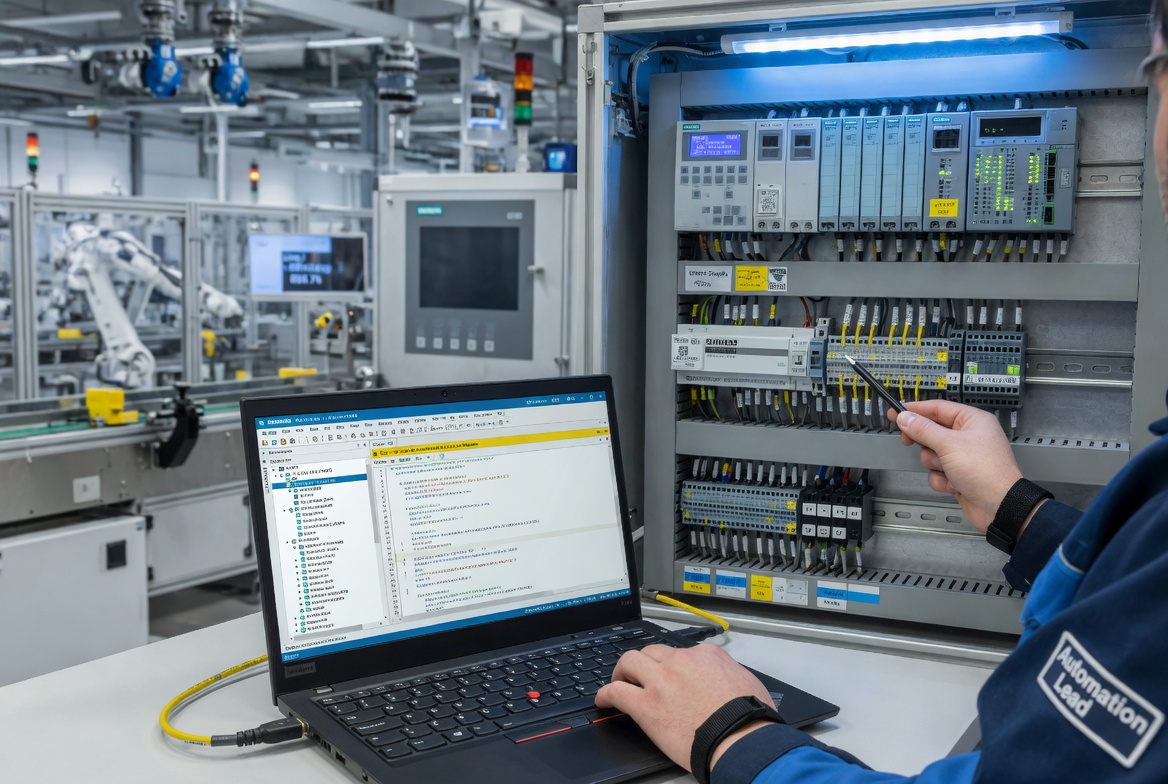
If recruitment is not working, there is a clear alternative
You do not need to win the hiring market to keep your production lines running and your capital projects moving. If your team is stretched, your last controls hire fell through, or you simply want to stop carrying that risk on the shoulders of one individual, an outsourced engineering partnership is a proven and increasingly mainstream answer.
To discuss a specific project or talk through whether an outsourced model fits your operation, get in touch with our team. We are happy to scope the work, talk through options, and give you a clear view of what delivery would look like.
Sources: MyWorkwear UK Manufacturing Skills Gap Report 2025; Make UK Industrial Strategy Skills Commission Report 2025; Institution of Engineering and Technology (IET) 2025 UK Engineering and Technology Skills Survey; Office for National Statistics, September 2024.