
Industrial Cybersecurity & IEC 62443: Protecting UK Factory OT & PLC Networks
A comprehensive engineering blueprint for UK plant managers and electrical leads. Discover how to segment Purdue Model zones and conduits, deploy deep packet inspection firewalls, eliminate unmanaged vendor remote access, and comply with UK HSE OG-0086 standards.
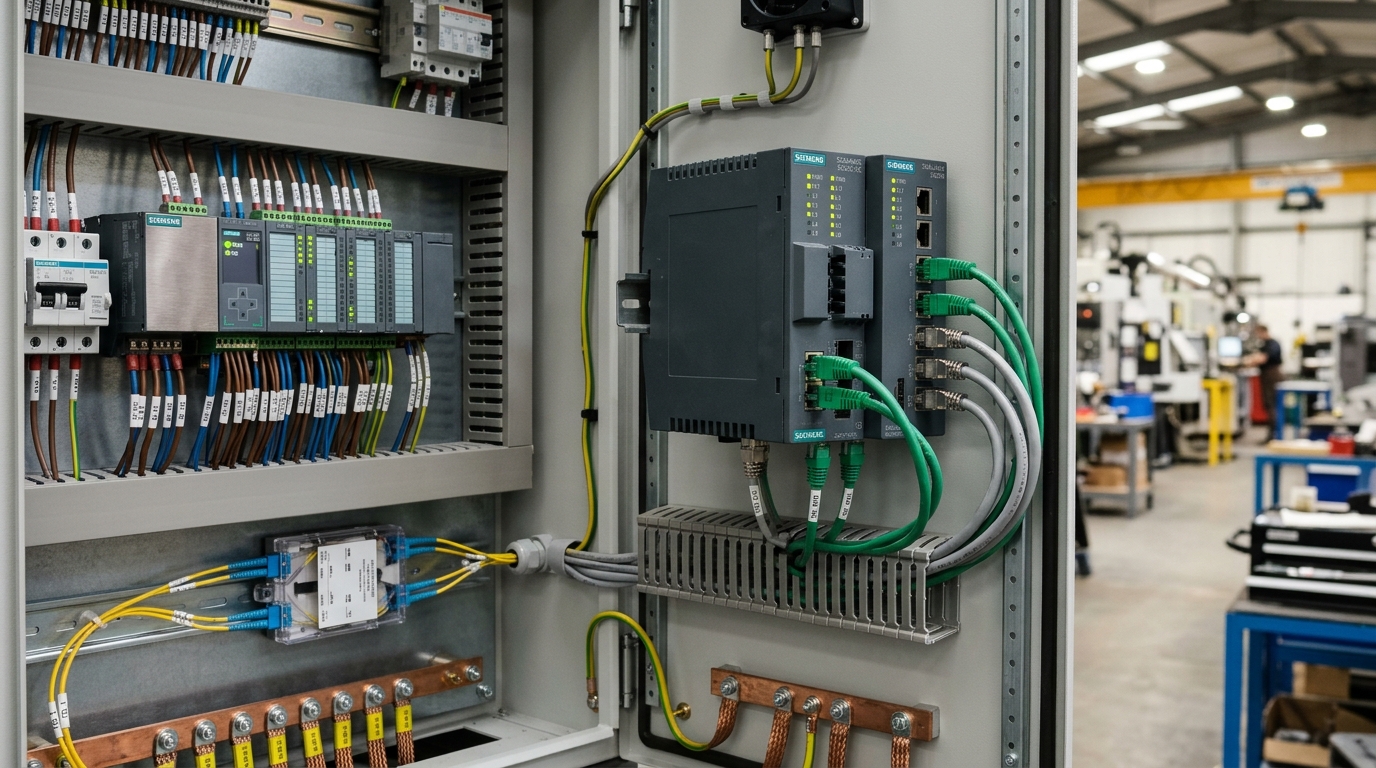
Executive Summary: The Fundamental IT vs OT Cybersecurity Paradox
For decades, factory automation relied on the assumption of physical isolation (the so-called air gap). Today, digital transformation, IIoT telemetry, cloud SCADA, and remote OEM support have permanently connected operational technology (OT) to enterprise IT networks. Applying standard corporate IT policies directly to the plant floor is disastrous:
AIC vs CIA Triad
Enterprise IT prioritises Confidentiality, Integrity, and Availability. Operational Technology enforces Availability, Integrity, and Confidentiality. A dropped packet in IT is an email delayed; in OT, it is a synchronous web-break or thermal runaway.
Deterministic Uptime
IT servers are rebooted monthly for operating system security patches. A continuous process PLC in a chemical, food, or steel facility cannot be rebooted without hours of line sanitisation and thousands of pounds in lost batch materials.
IEC 62443 Compliance
ISO 27001 governs corporate information security. The international gold standard for manufacturing systems is IEC 62443, mandating strict physical and logical network zones, conduits, and operational risk tiers.
1. The Purdue Enterprise Reference Architecture (ISA-95 / IEC 62443)
The foundational concept of industrial cybersecurity is structural segmentation. The Purdue Model divides a manufacturing enterprise into hierarchical levels, establishing distinct security perimeters (Zones) and tightly restricted communication paths (Conduits).
L0/L1Level 0 & Level 1: Field Process & Basic Control
Critical Deterministic ZoneContains physical field instrumentation (sensors, pneumatic valves, 4-20mA transmitters) and direct control hardware: PLCs, PACs, servo drives, and Variable Frequency Drives (VFDs). Communication protocols include PROFINET IO, EtherNet/IP, Modbus TCP, and EtherCAT. This zone must never possess a default internet gateway or direct routable path outside its local cell subnet.
L2Level 2: Area Supervisory Control
Operator Interaction ZoneHouses local touchscreens, operator interface panels (HMIs), engineering workstations, and alarm management systems. Communication into Level 1 is restricted strictly to necessary tag polling and setpoint downloads. USB ports and unauthenticated external drives must be mechanically or cryptographically disabled.
L3Level 3: Site Operations & Manufacturing Operations Management (MOM/MES)
Plant Operational CoreContains site-wide SCADA servers, batch recipe managers, local process historians, and asset health monitoring platforms. This layer aggregates data from multiple Level 2 production cells.
L3.5Level 3.5: The Industrial Demilitarized Zone (IDMZ)
Mandatory Security AirlockThe linchpin of industrial defense. No traffic is allowed to bridge directly between Level 3 (OT) and Level 4 (IT). All data exchange occurs via intermediate mirror servers inside the IDMZ (such as a replica SQL database, OPC UA proxy, or secure Remote Desktop jump box). Even if corporate office laptops are compromised by ransomware, the infection cannot cross the IDMZ boundary into machine controls.
L4/5Level 4 & Level 5: Corporate Enterprise & Cloud
Enterprise IT NetworkEnterprise Resource Planning (ERP like SAP or Oracle), corporate email, internet access, and cloud analytics. Any access from this zone into plant operations must terminate at the IDMZ.
2. Industrial Firewalls & Deep Packet Inspection (DPI)
Many plant engineering teams install a commercial IT firewall inside an enclosure and assume the plant is safe. However, standard stateful inspection stops at Layer 4 (Transport layer, TCP/UDP ports). In industrial networks, cyber attacks rarely use obscure exploit ports: they use legitimate industrial commands sent over valid ports to cause physical destruction.
How Deep Packet Inspection Protects PLC Fieldbuses
Industrial security appliances (such as Siemens SCALANCE S615, Phoenix Contact mGuard, Moxa EDR series, or Hirschmann Eagle) perform deep packet inspection by disassembling the industrial protocol header and data payload in real time:
Modbus TCP Inspection (Port 502)
A standard firewall permits all traffic on port 502. An industrial DPI firewall permits Function Code 03 (Read Holding Registers) from the plant historian while actively dropping Function Code 06 (Write Single Register) or Function Code 16 (Write Multiple Registers) coming from outside the authorised engineering workstation.
EtherNet/IP CIP Inspection (Port 44818)
DPI firewalls inspect the Common Industrial Protocol (CIP) service codes. SCADA systems are allowed to read process tags, but CIP commands attempting to force digital outputs, change the PLC operating mode (Run to Stop), or initiate a remote firmware upload are instantly blocked and logged.
3. Taming Third-Party OEM Remote Access & Rogue Modems
One of the largest attack vectors across UK manufacturing plants is unmanaged third-party vendor access. Packaging machinery from Italy, robotics skids from Germany, and chiller packages from the US frequently arrive with pre-installed 4G cellular modems or consumer software (TeamViewer, AnyDesk) installed on vendor laptops.
Cellular modems bypass all corporate firewalls, intrusion detection, and IDMZ boundaries. If an overseas machine builder suffers a cyber intrusion, attackers can pivot directly through their remote maintenance connection straight into your factory floor PLC bus.
The MASK Controls Blueprint for Secure Remote Maintenance:
Fit an industrial 2-position key switch on the exterior door of the control panel wired to the digital input of the industrial VPN router (such as an IXON, Secomea, or SCALANCE S). Remote access is physically disabled until an authorised plant shift manager turns the key, granting a defined 2-hour maintenance window.
Vendors must never receive a full subnet layer 2 bridge. Access is restricted exclusively to the specific PLC IP address and specific programming port required for their equipment.
All outbound connections from the factory gateway to the secure cloud portal require hardware security keys or authenticator apps. Static passwords and shared credentials are strictly prohibited.
Sessions are recorded with comprehensive connection logs showing exact timestamp, engineer identity, modified PLC tags, and program upload/download timestamps.
4. Practical Hardening Strategies for Legacy PLCs
In an ideal world, every controller on the plant floor would be a modern Siemens S7-1500 with TLS-encrypted communications, certified boot integrity, and hardware cryptographic processors. In the real world, UK factories rely on thousands of legacy Siemens S7-300, Rockwell SLC 500, PLC-5, and Omron CJ2 controllers that have operated reliably for 15 to 25 years.
4 Cost-Effective Steps to Defend Legacy Controllers:
Bump-in-the-Wire (BITW) Security Isolation
Install a DIN-rail security appliance directly ahead of the legacy Ethernet communications processor (such as a CP 343-1 or 1756-ENBT). The router creates an impenetrable micro-segment, blocking all broadcasts and unsolicited discovery requests.
Disable Insecure Embedded Services
Legacy PLC communication modules often have unauthenticated web servers, Telnet daemons, and FTP servers enabled by default for diagnostic convenience. Audit the hardware configuration in Step 7 or RSLogix and uncheck every protocol except the required industrial fieldbus.
Turn Keyswitches to RUN (Not REM)
Most older PLCs possess a physical 3-position keyswitch: RUN, REM (Remote), and PROG/STOP. In RUN position, the controller physically disallows remote program downloads, edits, or memory clears over the network. Keep production controllers locked in RUN mode and lock the physical key in the control room safe.
Air-Gapped Golden Image Backups
Maintain verified, offline binary backups of all PLC logic, HMI runtime files, and VFD parameter files on encrypted, write-protected USB drives stored in a physical fireproof cabinet. In the event of a ransomware attack, recovering in hours rather than weeks depends entirely on uninfected offline backups.
5. UK Health & Safety Executive OG-0086 & NIS Regulations
In the United Kingdom, cybersecurity on the factory floor is no longer solely an IT concern: it is governed directly by statutory Health and Safety law. The UK Health and Safety Executive (HSE) enforces Operational Guidance OG-0086: Cyber Security for Industrial Automation and Control Systems (IACS).
HSE OG-0086 Statutory Compliance
Under the Health and Safety at Work etc. Act 1974 and the Management of Health and Safety at Work Regulations 1999, employers must identify all foreseeable risks to plant and personnel. If an automated machine could inflict fatal crush injuries, toxic release, or fire due to a compromised PLC or safety network, failure to implement adequate cyber defenses is a criminal breach of safety duty.
The UK NIS Regulations 2018
The Network and Information Systems (NIS) Regulations apply to designated Operators of Essential Services (OES) across energy, water, transport, and healthcare, with expanding scope into critical supply chains and food production. Penalties for non-compliance and unmitigated incidents reach up to £17 million.
6. Technical Comparison: IEC 62443 Security Levels (SL 1 to SL 4)
IEC 62443 categorises security objectives into Target Security Levels (SL-T), Achieved Security Levels (SL-A), and Capability Security Levels (SL-C). Use the following reference matrix to determine the appropriate tier for your plant assets:
| Security Level | Threat Actor Profile | Attack Vector | Typical Countermeasures | UK Plant Application |
|---|---|---|---|---|
| SL 1 | Casual / Coincidental | Operator configuration error, infected USB stick, generic worm spreading on office LAN. | Basic VLAN separation, default password changes, USB port disabling, basic endpoint antivirus. | Non-critical auxiliary systems (packaging conveyors, raw material silo level logging). |
| SL 2 | Intentional (Low Resources) | Disgruntled employee, opportunistic script kiddie using automated scanning tools. | Purdue Model zoning, IDMZ deployment, industrial firewalls with basic stateful inspection, role-based access (RBAC). | Standard automated manufacturing cells, CNC production lines, bottling and canning halls. |
| SL 3 | Intentional (Sophisticated) | Organised cybercrime syndicates targeting intellectual property or demanding massive ransomware payouts. | Deep Packet Inspection (DPI), 802.1X port authentication, encrypted fieldbus traffic, multi-factor authentication, physical key interlocks. | Critical batch reactors, pharmaceutical formulation skids, main electrical distribution MCCs. |
| SL 4 | Nation-State / Advanced Persistent Threat (APT) | State-sponsored actors using bespoke zero-day exploits aimed at catastrophic national infrastructure shutdown. | Complete hardware air-gaps, unidirectional optical data diodes, SIL 3 hardwired emergency safety interlocks independent of software. | National power grid generation, major chemical/nuclear hazards (COMAH top-tier sites). |
7. Actionable 6-Step OT Cybersecurity Implementation Checklist
Map every connected device on the shop floor: MAC address, IP address, firmware version, PLC model, and physical switch port location. You cannot protect what you do not know exists.
Eliminate flat shop-floor networks. Break production areas into discrete VLANs and enforce conduit rules so that a broadcast storm or compromise on Packaging Line 1 cannot infect Line 2.
Establish a hardened Level 3.5 buffer zone. Ensure enterprise ERP queries access replica databases in the IDMZ rather than polling live shop-floor SCADA processors directly.
Remove all unmanaged 4G dongles and third-party remote control desktop software. Route all vendor access through MFA-secured VPN gateways equipped with physical cabinet key switches.
Fit physical RJ45 port blockouts on unused managed switch ports. Lock control panel doors with restricted key cylinders. Keep PLC processor keyswitches in RUN mode.
Create scheduled, verified offline backups of PLC logic, HMI projects, drive parameters, and switch configurations on dedicated write-protected physical media stored off-site.
Frequently Asked Questions: OT Cybersecurity & IEC 62443
Can a standard corporate IT firewall protect our shop floor PLCs and SCADA networks?
No. Commercial IT firewalls inspect typical office protocols such as HTTPS, SMTP, and DNS, but they have zero visibility into industrial fieldbus payloads like Modbus TCP, PROFINET, or EtherNet/IP CIP. A corporate firewall sees port 502 or 44818 open and permits all traffic, allowing malicious or corrupted commands to alter register setpoints, force physical outputs, or flash unauthorized controller firmware. Furthermore, enterprise IT firewalls lack industrial DIN-rail form factors, 24V DC power inputs, and -40C to +75C operating temperature ratings needed in manufacturing control panels.
What is the core difference between IEC 62443 Security Levels SL 1 to SL 4?
IEC 62443-3-3 defines four distinct Security Levels (SL) based on threat actor capability and intent: SL 1 defends against casual or coincidental unauthorized access (unintentional errors and non-targeted malware); SL 2 defends against intentional violation using simple means with low resources and generic skills; SL 3 protects against intentional cyber attacks using sophisticated means with moderate resources and IACS-specific knowledge; and SL 4 protects against national-level nation-state actors with extensive resources and bespoke zero-day exploits. Most UK manufacturing operations aim for SL 2 across standard production lines and SL 3 for critical utility and safety control loops.
How do we secure legacy PLCs that do not support onboard passwords or encrypted communications?
Legacy controllers such as Siemens S7-300 or Rockwell SLC 500 cannot be modified with modern TLS encryption or CPU authentication chips. The primary engineering solution is 'Bump-in-the-Wire' (BITW) perimeter defense: placing a compact DIN-rail security router (such as a Siemens SCALANCE S615 or Phoenix Contact mGuard) directly in front of the legacy rack. The router enforces 1:1 Network Address Translation (NAT), restricts inbound communication exclusively to designated engineering workstations via MAC and IP whitelisting, and uses Deep Packet Inspection to drop all unapproved write commands.
How does Deep Packet Inspection (DPI) prevent malicious attacks on industrial fieldbuses?
Traditional stateful packet inspection only checks source IP, destination IP, and port number. Deep Packet Inspection decodes the application layer payload inside industrial packets. For example, in Modbus TCP, DPI inspects the Function Code: it can allow Function Code 03 (Read Holding Registers) for SCADA telemetry while actively blocking Function Code 06 or 16 (Preset Single or Multiple Registers) and Function Code 05 (Force Single Coil) from untrusted subnets. On Rockwell EtherNet/IP, DPI can allow CIP generic read tags while blocking controller firmware updates or mode changes.
What is the UK HSE's regulatory position on industrial cybersecurity in factories?
The UK Health and Safety Executive enforces Operational Guidance OG-0086 ('Cyber Security for Industrial Automation and Control Systems'). Under UK safety legislation, if a cyber security breach can lead to a loss of physical process control, machinery runaway, environmental discharge, or safety system failure, it is treated as a statutory health and safety risk. Plant operators must demonstrate adequate risk assessment under BS EN ISO 12100 and enforce technical defense-in-depth under IEC 62443, or face formal Improvement Notices and potential prosecution.
Why is an Industrial Demilitarized Zone (IDMZ) critical between Level 3 and Level 4?
The IDMZ (Purdue Model Level 3.5) creates a complete security airlock between corporate enterprise networks (Level 4/5) and shop floor operational control (Levels 0 to 3). Direct network traffic must never pass between IT and OT. Instead, intermediate jump servers, mirrored historians, and terminal servers terminate sessions inside the IDMZ. An enterprise user connects into the IDMZ via multi-factor authentication; the IDMZ then initiates an independent, monitored session into the OT zone, preventing lateral malware transmission and ransomware propagation.
Hardening Your Factory Automation Against Cyber Threats
MASK Control Systems Ltd designs, builds, and commissions fully segmented, IEC 62443-compliant industrial control panels, Form 4 MCCs, and OT network architectures across the UK. Whether you require a comprehensive OT cybersecurity audit, industrial firewall installation, or legacy PLC hardening, our engineering team provides complete turnkey solutions.