
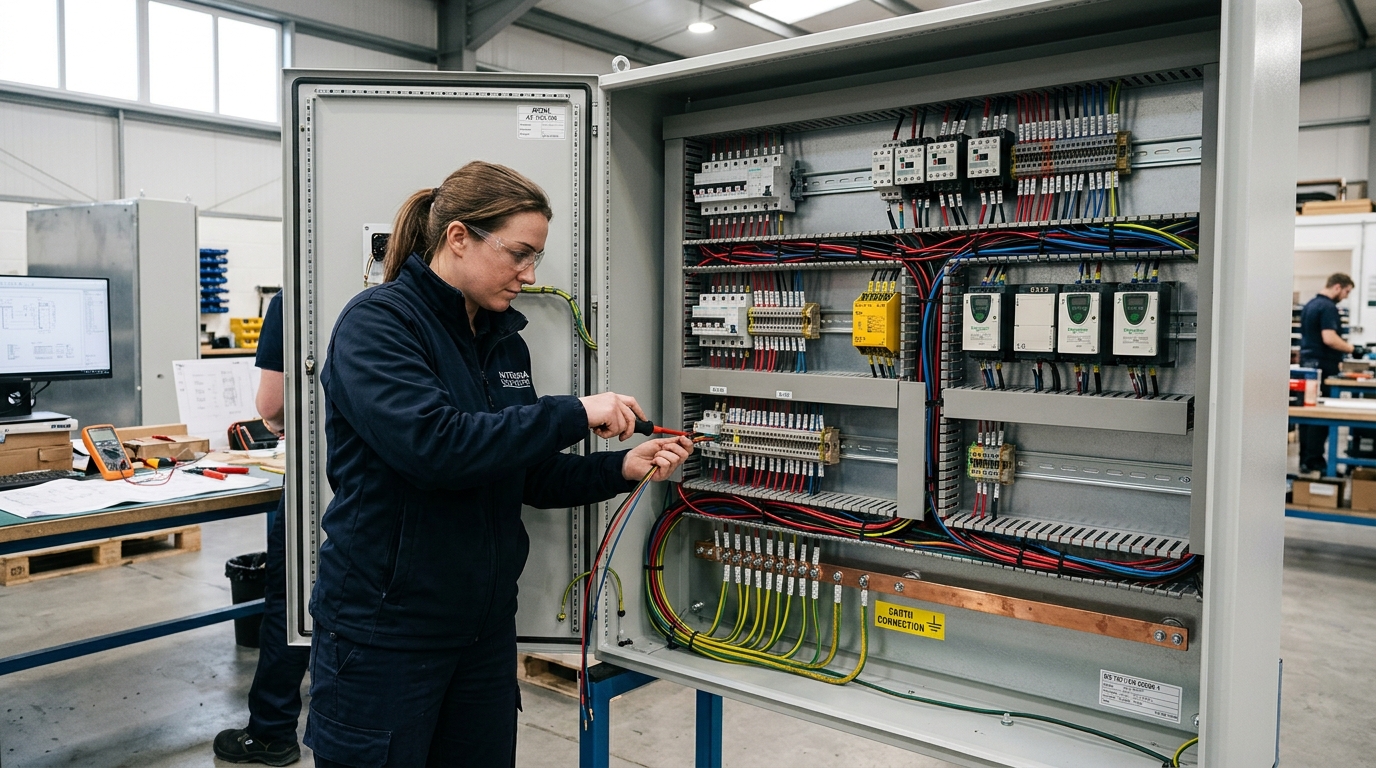
The Regulatory Framework: BS 7671 vs BS EN 60204-1
In the United Kingdom, designing and building an electrical control panel is governed by strict statutory instruments, primarily the Electricity at Work Regulations 1989, the Supply of Machinery (Safety) Regulations 2008, and the Provision and Use of Work Equipment Regulations (PUWER 1998).
A common question among machine builders and plant engineers is: "Where does the building electrical standard end, and where does the machinery control panel standard begin?"
The Point of Demarcation:
BS 7671 (IET Wiring Regulations, 18th Edition Amendment 2) applies to the fixed infrastructure of the building up to and including the incoming terminals of the machine main switch disconnector. The moment conductors pass through the panel incoming supply terminals, BS EN 60204-1 (Safety of Machinery: Electrical Equipment of Machines) takes precedence.
For power distribution boards and Motor Control Centres (MCCs) operating under general industrial switchgear duties, BS EN 61439-1 / 61439-2 applies. Failing to design enclosures to these harmonised British standards leaves factory operators vulnerable to catastrophic insurance claim rejections, failed statutory HSE audits, and severe criminal liability in the event of an electrical injury. Discover our certified manufacturing approach on our Electrical Control Panel Design Hub.
The 4 Primary UK Standards in Industrial Panel Engineering:
IET Wiring Regulations (18th Edition)
Fixed electrical infrastructure, supply disconnection times, surge protection (SPDs), and earthing systems.
Safety of Machinery: Electrical Equipment of Machines
Machine control panels, incoming isolators, operator interfaces, emergency stop circuits, and conductor identification.
Low-Voltage Switchgear & Controlgear Assemblies
Power distribution boards, motor control centres (MCCs), form of internal separation, and busbar short-circuit withstand.
Safety-Related Parts of Control Systems
Functional safety design, Performance Levels (PLr a to e), Category 1 to 4 architectures, and diagnostic coverage.
Short-Circuit Current Rating (SCCR) and Fault Containment
One of the most frequently failed criteria in third-party panel audits is the Short-Circuit Current Rating (SCCR). Every industrial electrical cabinet must be rated to safely withstand the prospective short-circuit fault current delivered by the facility substation.
If an electrical control panel has an internal component rating of 10kA, but is installed on a factory distribution bus capable of delivering 35kA prospective fault current, an internal phase-to-phase short will cause catastrophic thermal expansion, vaporize copper busbars, and blow the cabinet doors off their hinges in an arc flash explosion.
A control panel overall SCCR is governed by the lowest-rated protective device or power component in the fault path. To achieve high fault ratings (e.g., 25kA, 50kA, or 65kA), engineers must deploy coordinated upstream current-limiting fuses or Molded Case Circuit Breakers (MCCBs) tested for Type 2 coordination under BS EN 60947-4-1.
Forms of Internal Separation (BS EN 61439-2)
To protect maintenance technicians from accidental contact with live high-voltage busbars while servicing control components, BS EN 61439 defines distinct Forms of Separation:
Standard compact machine control panels. Busbars, functional units, and terminals all share a common interior enclosure space without barriers.
Main copper busbars are physically partitioned from functional units and output terminals, preventing accidental busbar contact during maintenance.
Busbars are segregated from functional units, and each motor starter or drive compartment is separated from other units.
High-integrity Motor Control Centres (MCCs). Each functional unit, its associated outgoing terminals, and the busbars are completely enclosed in independent metallic compartments.
Thermal Management and Enclosure Heat Dissipation
Modern industrial control panels pack high concentrations of heat-generating silicon into sealed enclosures: Variable Frequency Drives (VFDs), 24V DC switch-mode power supplies, servo amplifiers, and high-speed PLC processors.
Every electrical enclosure design must include a verified thermal dissipation calculation. The fundamental heat transfer equation used by our design team is:
Where Delta T is the internal temperature rise, P_internal is total thermal losses in Watts, k is the enclosure material heat transfer coefficient (typically 5.5 W/m²K for painted sheet steel), and A_effective is the usable radiating surface area under BS EN 60204-1.
If the internal cabinet temperature exceeds 35 degrees Celsius, component lifespans degrade exponentially. Depending on ambient environment and ingress protection ratings (IP54 to IP66), we deploy three cooling tiers:
- Natural Convection & Roof Louvres: Suitable only for low-density panels where total internal heat generation does not exceed cabinet radiant capacity.
- Forced Filter Fans: Ideal for clean ambient manufacturing areas where outside air temperature remains at least 5 degrees below target internal temperature.
- Closed-Loop Air Conditioning Units: Essential for food washdown (IP66 stainless steel) or high-temperature metal stamping plants where airborne moisture, dust, or oil mist must never enter the cabinet.
Conductor Color Standards Under BS EN 60204-1
Standardized wiring color codes eliminate dangerous misinterpretations during emergency breakdowns and routine maintenance. Under BS EN 60204-1 clause 13.2, all conductors within a UK machinery control panel must comply with the following color standards:
| Circuit Classification | Specified Wire Color | Regulatory Standard |
|---|---|---|
| 3-Phase AC Power (L1, L2, L3) | Brown, Black, Grey | Harmonized UK & European Phase Standards |
| AC Neutral Conductor (N) | Blue | Single-phase and neutral distribution |
| AC Single-Phase Control Circuit | Red | 110V AC or 230V AC internal machine control |
| DC Control Circuit Positive (+24V DC) | Dark Blue | Standard industrial PLC & sensor logic |
| DC Control Circuit Negative (0V DC) | Dark Blue or Grey | Standard sensor common ground return |
| Interlocking External Circuits (Remains Live) | Orange | Remains energized when main isolator is open |
| Protective Earth Conductor (PE) | Green with Yellow Stripe | Dedicated earthing and equipotential bonding |
Under no circumstances may interlocking wires supplied from an external control source be wired in black or red. They must be bright orange to immediately alert electrical personnel that turning off the main cabinet rotary isolator does not de-energize those specific terminals.
Functional Safety & Emergency Stop Integration
Under BS EN ISO 13849-1, machine safety circuits must achieve a designated Performance Level (PLr) from PLa through PLe based on risk severity, frequency of exposure, and possibility of avoidance.
Industrial control panels designed by MASK Controls implement Category 3 or Category 4 redundant architectures. Rather than simple single-channel emergency stops that fail dangerously upon a single welded contact, our panels feature dual-channel monitoring with pulsed cross-fault detection.
Where multi-zone safety or robot cell integration is required, we deploy integrated Failsafe Safety PLCs (e.g., Siemens S7-1500F with PROFIsafe or Allen-Bradley GuardLogix with CIP Safety). This eliminates dozens of physical safety relays, simplifies cabinet trunking, and delivers live diagnostic status directly to the machine HMI.
Statutory Testing and The UKCA / CE Technical File
Before any electrical control panel leaves our workshop, it undergoes mandatory routine verification testing under BS EN 60204-1 clause 18:
Verifying low-resistance protective bonding (typically below 0.1 ohm) from the incoming PE terminal to all metallic doors and backplates.
Applying 500V DC megger testing between power conductors and the protective earth, requiring a minimum of 1.0 Megohm resistance.
Dielectric voltage testing at 1,000V AC or twice rated voltage for 1 second to confirm clear separation distances.
Every completed panel is accompanied by a full Technical Construction File (TCF), including EPLAN CAD electrical drawings, calibrated test certificates, short-circuit withstand reports, and an authorized UK Declaration of Conformity granting legal UKCA marking authority. Learn about our on-site handover standards on our Installation & Commissioning Page.
Frequently Asked Questions About Control Panel Standards
What is the primary difference between BS 7671 and BS EN 60204-1 for control panels?
BS 7671 (the IET Wiring Regulations) governs fixed electrical installations within buildings up to the incoming supply terminals of the machine. BS EN 60204-1 specifically governs the electrical equipment and control systems of industrial machinery starting from the main incoming isolator switch, addressing machine-specific hazards, emergency stops, actuator interlocks, and operator safety.
Why is Short-Circuit Current Rating (SCCR) critical in industrial panel design?
SCCR defines the maximum prospective fault current (in kA) an electrical panel can safely withstand without exploding, igniting an arc flash, or vaporizing internal busbars. If a panel with a 10kA rating is connected to a factory substation capable of delivering 35kA fault current, an internal short-circuit will destroy the enclosure and create lethal conditions for nearby personnel.
How is thermal dissipation calculated when sizing enclosure cooling?
Thermal dissipation calculates the total internal wattage heat loss from active components (VFDs, transformers, DC power supplies, PLC racks, and contactor coils) against the enclosure effective surface area and ambient plant temperature. If natural radiation cannot dissipate internal heat below 35 degrees Celsius, forced air filtration fans, vortex coolers, or closed-loop air conditioners must be installed.
What wire color code is required for 24V DC and interlocking circuits in the UK?
Under BS EN 60204-1, 24V DC positive (+) power and control conductors are designated dark blue, while 0V DC (-) conductors are dark blue or grey. Critically, any interlocking circuit or remote telemetry wire that remains energized when the main cabinet isolator is switched off must be identified in bright orange to warn service technicians.
What documentation is required to achieve legal UKCA and CE marking on a control panel?
A complete Technical Construction File (TCF) is required, containing full EPLAN or AutoCAD Electrical schematics, bill of materials with component certs, risk assessments to EN ISO 12100, short-circuit withstand calculations, heat dissipation reports, routine dielectric test records (megger 500V DC and earth bond testing), and a formally signed UK Declaration of Conformity.
Can uncertified or self-built control panels be insured in the UK?
Underwriters and industrial property insurers in the UK routinely reject claims arising from electrical fires if the switchgear or machinery control panel lacks verified compliance with BS EN 60204-1 and BS 7671. Uncertified panels violate the Electricity at Work Regulations 1989 and expose company directors to statutory prosecution by the Health and Safety Executive (HSE).