
How Industrial Automation Boosts Factory Output & Cuts Unplanned Downtime: An Engineering Blueprint
Unplanned downtime drains thousands of pounds per hour from UK manufacturing plants. Discover 5 battle-tested automation engineering strategies that eliminate bottlenecks, implement predictive maintenance telemetry, and elevate Overall Equipment Effectiveness (OEE) above 85%.
Executive Overview: The Financial Reality of Industrial Downtime
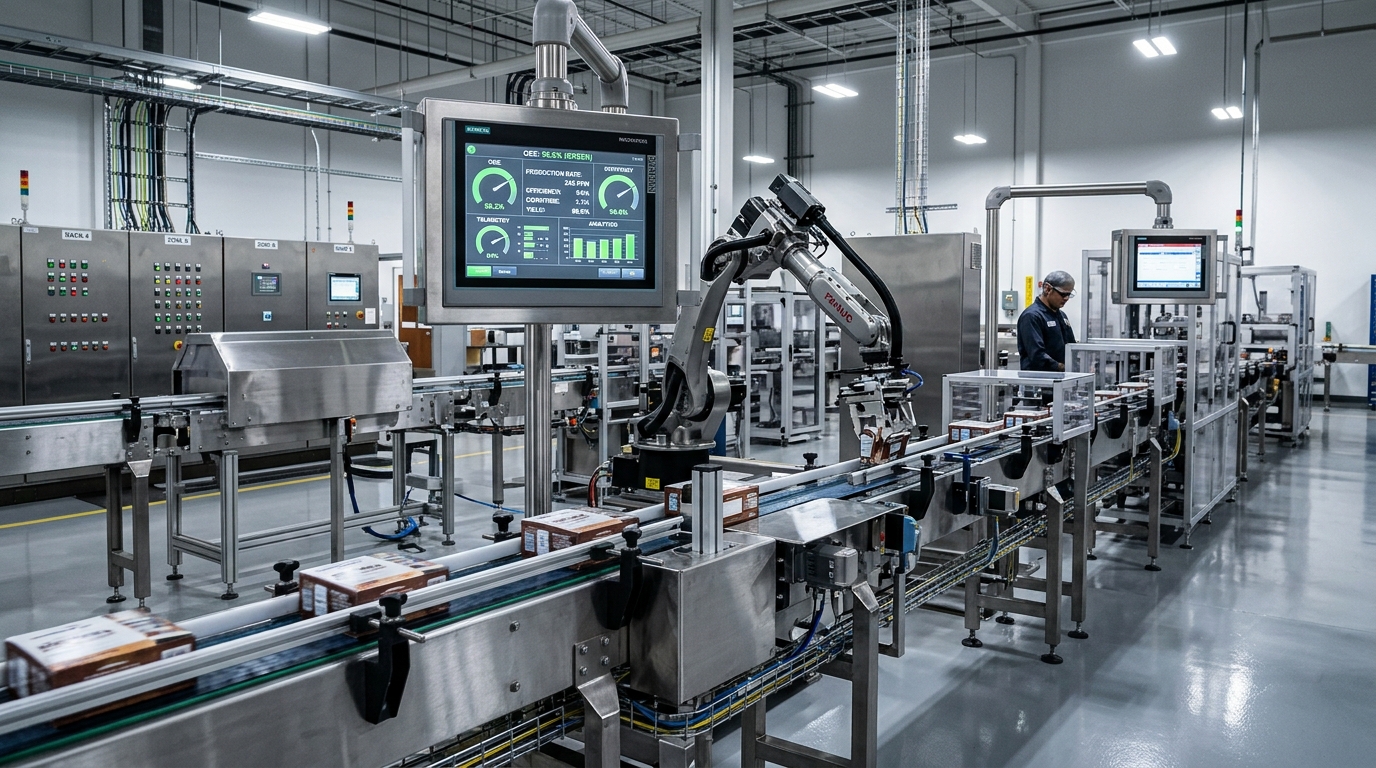
In modern competitive manufacturing, profitability is determined at the margins of machine availability and line synchronization. In sectors such as food and beverage, specialty chemical synthesis, high-speed cartoning, and automotive components, an unscheduled stoppage does not merely pause production; it triggers product spoilage, expensive manual clean-in-place (CIP) purges, missed dispatch deadlines, and contractual delay penalties.
Industrial automation is not merely about replacing human labour; it is an engineering discipline designed to eliminate variability. By deploying high-speed deterministic controllers, intelligent sensor telemetry, automated alarm rationalization, and redundant network architectures, UK plant managers can convert unpredictable firefighting into predictable, highly profitable production uptime.
Eliminating Bottlenecks Through Coordinated Multi-Axis Control
A factory line is only as fast as its slowest mechanical transition. In unoptimized packaging, filling, or palletizing lines, micro-stoppages (stoppages under 2 minutes caused by conveyor misalignments, sensor chatter, or manual buffer overflows) account for up to 60% of lost production capacity over a single shift.
Conveyors run at fixed speeds via basic contactors. Upstream machines flood downstream accumulation tables, triggering frequent stop-start stress on gearboxes, repeated can/bottle collisions, and constant operator intervention.
Dynamic Variable Frequency Drives (VFDs) communicate over PROFINET or EtherNet/IP with microsecond synchronization. Conveyor speeds automatically ramp up and down based on laser accumulation sensors, maintaining smooth laminar material flow and zero micro-collisions.
Explore how MASK Control Systems designs integrated motor control and conveyor synchronization into custom switchgear on our Electrical Control Panel Design service page.
Predictive Maintenance Telemetry: Shifting from Reactive to Proactive
Traditional preventive maintenance relies on calendar schedules or runtime hours. Technicians replace bearings or lubricate pumps regardless of whether the component requires attention, or worse, components seize unexpectedly midway through a critical production run.
Modern automation deploys IO-Link digital instrumentation and drive telemetry directly into the PLC processor to capture real-time mechanical health indicators:
High-frequency MEMS sensors on motor bearing housings detect micro-inch raceway spalling and imbalance up to 6 weeks before audible noise or physical failure.
Smart VFDs monitor subtle variations in stator current waveforms, flagging broken rotor bars, gearbox tooth wear, and pump cavitation during normal operation.
Contactless infrared and PT100 RTD sensors monitor terminal blocks, busbars, and winding insulation, alerting engineers to loose connections before an arc event develops.
By routing predictive telemetry into cloud SCADA dashboards, maintenance managers schedule component swaps during planned weekend sanitization windows, eliminating catastrophic midday breakdowns.
Real-Time OEE Metrics & Automated Alarm Rationalization
Overall Equipment Effectiveness (OEE) is the gold standard manufacturing metric, multiplying Availability, Performance, and Quality. In paper-based or unintegrated facilities, OEE is calculated manually at the end of the shift, reporting losses hours after they occurred.
When a downstream sealer trips on a legacy packaging line, upstream accumulators, checkweighers, and conveyors immediately fault in cascade, generating 150 alarms within 5 seconds. Operators face screen paralysis trying to decipher the root cause.
Explore how MASK Control Systems implements modern supervisory control via our dedicated Systems Integration and SCADA development capabilities.
Rapid Fault Localization & Web-Based Controller Diagnostics
When a machine trips, Mean Time to Repair (MTTR) is divided into two distinct phases: Time to Diagnose (typically 80% of total outage duration) and Time to Fix (20%).
Modern controllers (Siemens S7-1500, Allen-Bradley GuardLogix) host secure HTTPS web servers. Technicians connect via standard tablet or mobile browser to view live hardware backplane LED states and physical terminal voltages without opening enclosure doors.
Through hardened industrial cellular routers and encrypted VPN tunnels, MASK Control Systems senior automation engineers connect to your plant network within minutes of a callout, diagnosing complex interlock traps without travel delays.
Discover how remote diagnostics protect continuous manufacturing facilities via our Remote Monitoring Solutions.
High-Availability Redundancy & Ethernet Ring Topologies
In continuous 24/7 processing environments (e.g. municipal water treatment, chemical batching, automated cold storage), single points of electrical failure cannot be tolerated. Modern industrial network engineering employs high-availability architectures:
Device Level Ring (DLR) & MRP Ring Topologies
By wiring field Ethernet devices in a closed physical ring under Media Redundancy Protocol (MRP) or EtherNet/IP DLR, a severed Cat6 cable or broken fiber strand automatically switches communication direction in under 10 milliseconds, preventing line stoppages.
Hot-Standby Dual Processor Synchronization
Critical utilities run dual redundant PLC processors (e.g. Siemens S7-1500R/H or ControlLogix Redundancy) linked via high-speed dedicated fiber optic cables. If the primary processor suffers a power failure, the secondary processor assumes bumpless control in zero clock cycles.
Downtime Cost Analysis & Automation Payback Matrix
Calculating the financial return of downtime-reduction automation in typical UK manufacturing sectors:
| Manufacturing Sector | Avg Cost of Downtime / Hr | Automation Intervention | Estimated Payback Period |
|---|---|---|---|
| High-Speed Bottling & Canning | £12,000 to £35,000 | Conveyor dynamic VFD synchronization & accumulation control | 3 to 6 Months |
| Automotive Tier-2 Sub-Assembly | £25,000 to £70,000 | Legacy SLC 500 PLC migration & CIP safety integration | 4 to 8 Months |
| Continuous Polymer Extrusion | £18,000 to £45,000 | Predictive motor vibration telemetry & temperature regulation | 5 to 9 Months |
| Commercial Bakery & Confectionery | £10,000 to £28,000 | ISA-18.2 alarm rationalization & automated CIP sequencing | 4 to 7 Months |
Table 1: Economic payback analysis demonstrating capital recovery through prevented unscheduled outages.
Frequently Asked Questions: Automation Downtime Mitigation
How does industrial automation directly reduce unplanned factory downtime?
What typical OEE improvements can UK manufacturers expect after automation upgrades?
What is predictive maintenance telemetry and how does it prevent motor burnouts?
How does automated alarm rationalization improve operator response times?
Can automation be installed on brownfield machinery without replacing entire lines?
What is the average payback period for downtime-reduction automation projects in the UK?
Eliminate Costly Factory Downtime with MASK Control Systems
Stop losing valuable production hours to avoidable machinery trips and obsolete controls. Speak directly with our UK automation engineers to schedule an on-site line throughput and OEE audit.